Burnett School of Medicine at TCU Faculty Members Showcase Medical Research
More than 100 physicians, clinicians, and researchers packed the Amon G. Carter Inspiration Commons Learning Studio at Anne Burnett Marion School of Medicine at Texas Christian University for the Faculty Research Symposium.
FORT WORTH – More than 100 physicians, clinicians, and researchers filled the Amon G. Carter Inspiration Commons Learning Studio at Anne Burnett Marion School of Medicine at Texas Christian University showing off the power of collaboration in research.
There has been a wonderful transformation in how TCU approaches research with the medical school becoming a bigger part of that mission, Greg Kearns, PharmD, Ph.D., Associate Dean for Research at Burnett School of Medicine said.
Research is “capturing the minds of our students and the minds of other faculty. That tells me that research is alive and well and it’s going to keep growing,” Kearns said.
There were 48 research posters presented during the 2nd annual Burnett School of Medicine at TCU Faculty Research Symposium. This year’s theme was inspiring the physicians of tomorrow through research, scholarship, and innovation.
Working on ground-breaking research is not done alone, according to Kayla Green, Ph.D., Associate Professor at Burnett School of Medicine at TCU.
“I think it’s a misconception that the faculty are the ones who are doing the research,” Green said. “Faculty are the ones leading the research and putting the group together to implement the research.”
Her research group, called the Green Research Group, presented a poster titled “Antioxidant Small Molecules Targeting Alzhiemer’s, Cataracts and More!”
Their research is a collaborative effort between the Burnett School of Medicine, the TCU Chemistry and Biochemistry departments, and students. Jack Bonnell, MS2, is a member of Green’s research lab. He helped attendees learn more about their research.
“A faculty member has two hands and most of the time those hands are going to be employed writing grants and ensuring that papers are published in a timely manner,” Green said. “It’s the students who are asking the questions and who are creating new knowledge.”
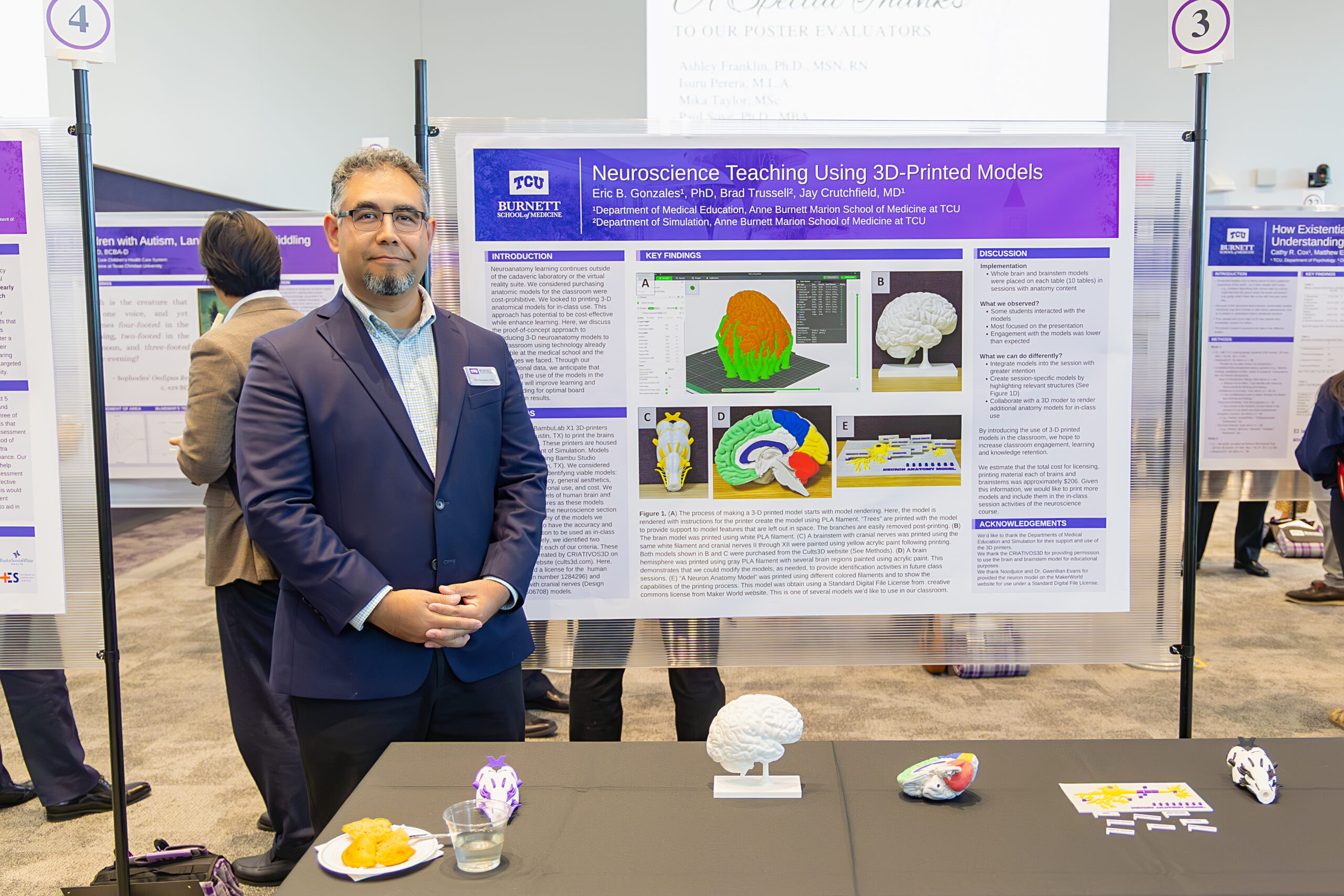
The spirit of collaboration in research stretched beyond working with students. The variety of contributors in the posters presented included physicians and researchers from all the major health systems in Tarrant County. Eric Gonzales, Ph.D., Professor of Medical Education at Burnett School of Medicine presented his work with the Simulation and Technology team at the medical school.
His poster titled “Neuroscience Teaching Using 3D-Printed Models” looked at using 3D printed anatomical models for in-class use to enhance neuroanatomy learning outside of the cadaveric laboratory or the Microsoft HoloLens® and HoloAnatomy virtual reality suite used at the medical school.
The 3D printed models of the brain can be produced for roughly $10 per model in comparison to more than $500 from larger technology vendors, according to Gonzales. His models can be customized with labels and colors for use in small quizzes. This could be replicated and bridge the gap between people who are tactile learners and those who are visual learners in a classroom.
“They have sessions on slides, they have notes but maybe they need a three-dimensional model in their hands to help solidify their learning,” Gonzales said.
Learning to harness the power of research through collaboration can also be physicians working with organizations.
Terri Weinman, D.O., Assistant Professor at Burnett School of Medicine presented her poster on “The Implementation of a Perinatal Organ and Tissue Donor Program – Helping Families in Need” in collaboration with LifeGift.
Dr. Weinman works with high-risk pregnancies where there may be a shortened life expectancy for infants. They have developed a protocol where select families could plan to donate their infant’s organs and/or tissue following their death.
Over the past three years, the lifesaving donations have provided patients with heart valves, biliary tree, liver, pancreas, kidneys with ureter, and femurs for research.
“I collaborated with LifeGift so that they can answer the family’s questions correctly,” Dr. Weinman said.
Dr. Weinman was one of four faculty members who were recognized with the 2025 Faculty Research Symposium Award, which is given to those with particularly outstanding poster presentations. A panel of evaluators recognized these four presentations:
- Sarah Merchant, M.D., and Lynn Roppolo, M.D. (Emergency Medicine) – A Multi-Center Study on eFAST Longitudinal Learning Curves for EM Residents Using CUSUM Analysis
- Eric Chou, M.D. (Emergency Medicine) – High-sensitivity Troponin as a Predictor for Major Adverse Cardiac Events in Chronic Kidney Disease Patients Presenting with Chest Pain
- Terri Weinman, D.O. (Pediatrics) – The Implementation of a Perinatal Organ and Tissue Donor Program – Helping Families in Need
- Charles West, M.D. (Surgery) – Structural Aortic Shift and Supra Aortic Angle Configuration Changes After Subclavian to Carotid Transposition as a Proposed Mechanism for Relief of Severe Esophageal Compression in Aberrant Subclavian Artery Anatomy
Having the medical school become more of a hub to support clinicians in Fort Worth to solve complex problems is a boon for the healthcare in the community, Kearns added.
“The process of discovery in clinical medicine with perplexing patient diagnosis requires a curious mind to find solutions,” Kearns said. “That’s what our faculty are bringing to these endeavors.”