Resilience
by Peggy Godfrey
No promises the wind will make
Unto the tender grasses
Nor leave a trace or memory
Nor count the time that passes.
In gentle breeze or howling storm
Passion ebbs and flows
Resisting not, the grasses bend
Tremble, sing, and moan.
Without the wind the grasses
Never have a chance to know
Their grace or range of motion
Songs of joy or woe.
As though in battle with the wind
The lifeless creak and grown
Stiffly clattering in the breeze
To break beneath the storm.
But, oh, to watch the living
Bid welcome to the wind
Wind and grass so separate
In union once again.
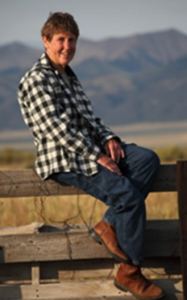
Peggy Godfrey is my exceptionally talented sister, Colorado rancher, and respected cowboy poet who has published four collections of her authentic cowboy poetry and prose including Write ‘em Cowboy (1993), Write ‘em Roughshod (1994), Write Tough (1995), and Stretchmarks (2003). Resilience is one of my favorites. The visual and auditory imagery of the grass and the wind reveals Peggy’s keen observation of nature and awareness of her environment. More importantly, she reflects on her life experiences which have ebbed and flowed as the grass bending in the wind. Her lyric captures this certainty: without stress, we cannot develop our full potential of “grace or range.” The weak, rigid, and inflexible, unable to learn and adapt, will fail in the storm.
Resilience is the ability to endure, recover, and grow stronger in the presence of adversity. All worthy endeavors, especially medical school, residency, and the life-long role of physician require resilience. We confront adversity and endure; face failure and recover; accept the “no’s,” adapt, and become stronger. Brilliance and skill alone are insufficient to sustain us through training and medical practice. Like the grasses, we must “bend, tremble, sing, and moan” to find our “grace or range of motion” in our “times of joy or woe.” It is no coincidence that Coach Thu and I are paired in Team Resilire. My sister and I were truly blessed, as children and well into our adult lives, to learn to be resilient from a father who lived to 104 years.
Our father was the personification of “The Greatest Generation” and a gold standard role model for resilience. He was a small-town boy from Arcadia, LA, who in his teens endured The Great Depression of the ’30s. He attended Louisiana Tech at the age of 16, playing football and boxing. He subsequently attended medical school at LSU School of Medicine in New Orleans where he met “Scooper.” They married in 1941 – the same year he was called up to serve in the violent WWII battles in the Pacific. He served as a front-line physician in the Philippines Islands. Despite the grave adversities of war, he advanced to Regimental Surgeon and earned the Silver Star, Bronze Star, and Presidential Unit Citation for leadership and uncommon valor saving wounded soldiers under fire. Later in his life, he treasured the reunions with “my boys” the dozen or so remaining medics who were in his command during WWII.
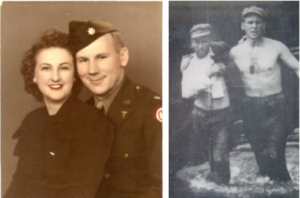
After the war, he completed another two years of residency training before becoming a family physician in Homer, LA in 1947. (Tom, Jr arrived in 1948.) It was a difficult and demanding life of frequent house calls day & night, superimposed on long hard days in the office and hospital. In establishing his medical practice and as a community leader and moral voice, he faced adversities with wisdom and grace—enduring, recovering, and growing stronger.
As a child, I felt no calling to medicine – a difficult profession that demanded so much of my father. I recall thinking, “I never want to work that hard.” However, he thrived in the joy of his intense physician work-life. He was also a prolific writer, reflecting often in prose and poetry on life’s joys and sorrows. His reflections encompassed his World War II experience, my mother – “Scooper,” the love of his life, family, and his role as a small-town family physician, community leader, and man of faith. His passion for medicine, joy in his work, and his unconquerable resilience were ultimately the reasons I altered my choice of profession from research chemist to physician four years after college graduation.
Here is an excerpt from a letter I wrote him in 2014 when he was 98-years-young and I was just a kid of 66:
Dad, I cannot tell you how much it has meant to me to have you as a model of a caring physician devoted to your patients and profession. I share your enthusiasm for the diagnostic challenge. It has been such a satisfying career. I cannot imagine my life if I had not found my way to medicine. For that, I am most grateful to you and your great example. I treasure the notebook that you prepared in 1946 to start your practice which summarized the current therapies of the day. A chair from your office waiting room is in my home study to remind me of your successful medical career as a beloved family physician.
My Dad died in May 2020 at the age of 104, my father, my role model of resilience finally let go. He died peacefully in his sleep of unknown causes and in perfect health. I would have described his cause of death as “resilience exhaustion.” He left this verse in reflection, his variation on Tennyson’s Crossing the Bar.
Sunset and evening star,
When I put out to sea
When I go across the Bar,
I want no tears for me.
For I am very much alive,
Though I lie with unseeing eyes,
I lie not dead…
I am forever thankful that he gave me his name, his profession, and his resilience which does indeed live on.
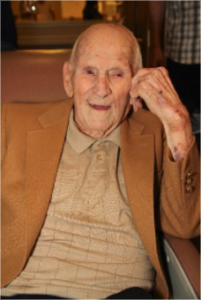
Thomas M. Deas
1916-2020