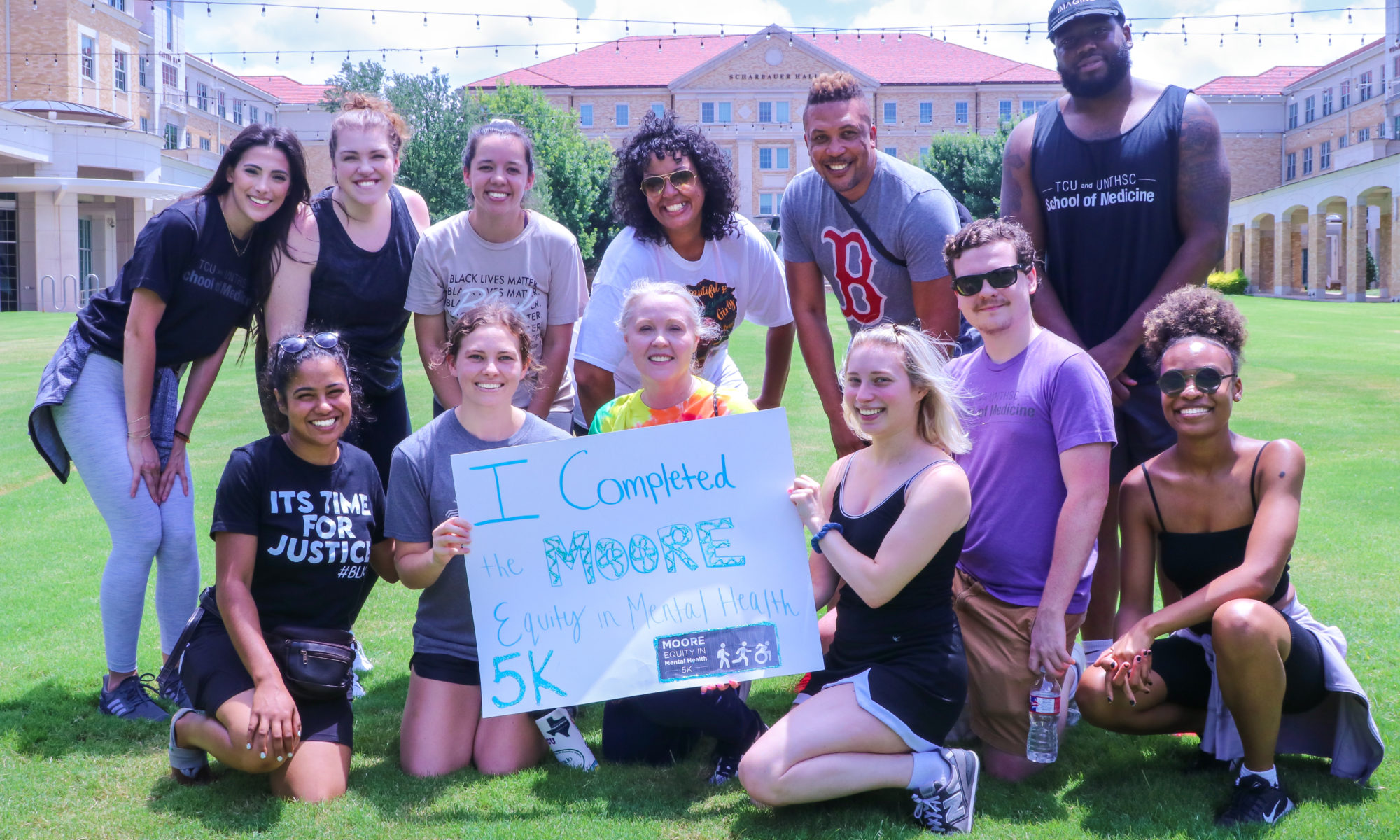
FORT WORTH – A group of medical students at TCU and UNTHSC School of Medicine pounded the pavement around TCU’s campus to celebrate the inaugural Moore Equity in Mental Health 5K walk, run or roll event.
“I think it really just spoke to the fact that we really need to raise awareness about the inequities in mental health especially with our youth,” said Aya Al-Adli, MS-2 and vice president of the psychiatry student interest group at TCU and UNTHSC School of Medicine.
The virtual event was held all across the U.S. on Saturday, July 10, by the American Psychiatric Association was done to celebrate Bebe Moore Campbell who was an American author, journalist, teacher and mental health advocate whose work helped shed light on the mental health needs of the Black community and other underrepresented communities across the country.
The event began with a livestream on the APA’s Youtube page with guest speakers Vivian Pender, M.D., APA President, Saul Levin, M.D., M.P.A., APA CEO and Medical Director and NFL veteran and broadcaster Brandon Marshall.
Marshall, who publicly struggled with mental health issues during his playing career, spoke about his personal struggles and how more needs to be to combat the stigma around mental health.
“When someone of that stature is suffering from it and he’s putting it on display in front of everybody it makes it a little bit easier for the next to me to say maybe I’m dealing with some things that are mental health issues and I want to seek help,” said second-year medical student Antonio Igbokidi.
The 5k initiative that is co-organized by the APA’s Division of Diversity and Health Equity and the APA Foundation challenged participants to also raise money for the APA Foundation’s Moore Equity in Mental Health Community Grants Initiative. The money will help provide education about the mental health needs of young people of color and support individuals and organizations that develop and provide culturally sensitive mental health services, according to the APA.
The medical school’s Psychiatric SIG raised $1,000 during the event to donate to the APA’s foundation.
“It’s all going back to grassroots organizations which is wonderful,” said Emma Difiore, MS-2. “I think mental health is on everyone’s radar and I think we really need to bring equity into the conversation.”
FORT WORTH – Getting accepted into medical school is something that most people would consider as beating the odds.
For Isabella Amado, a first-year medical student at TCU and UNTHSC School of Medicine, getting accepted into medical school was actually the second time she beat the odds to do something most people dream of doing.
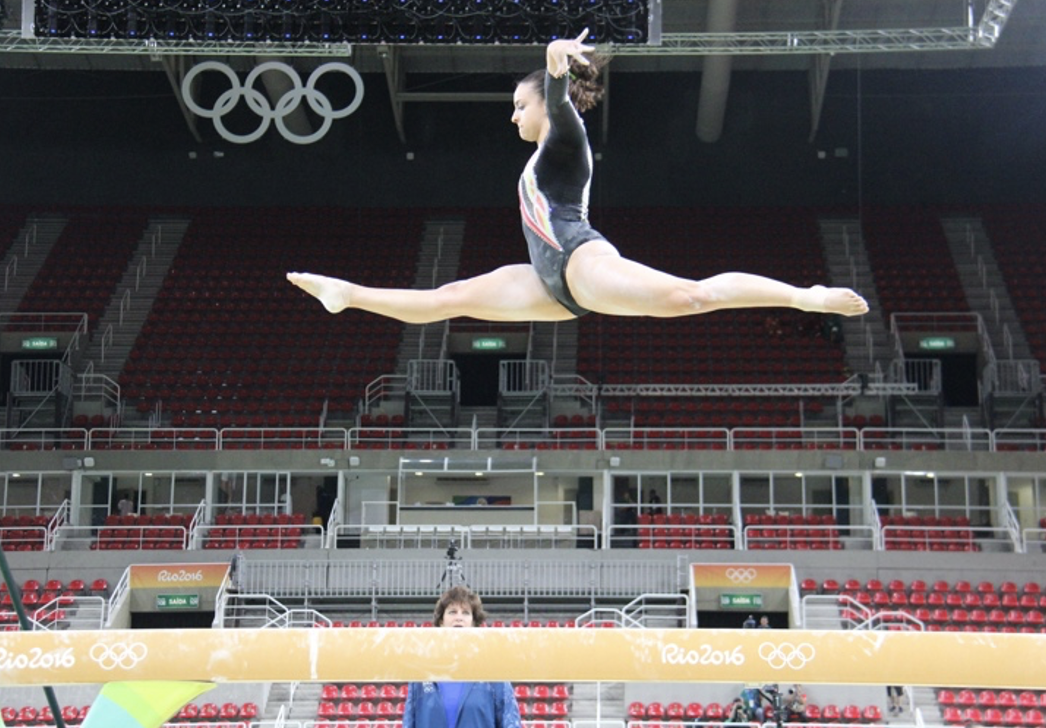
“It was very surreal to be competing on the biggest sporting stage in the world at the 2016 Olympics in Rio,” Amado said. “That’s what I had been dreaming of since (I was) 5 years old when I started the sport. Before me, there had not been a gymnast from Panama at the Olympics. I was so excited to be there and be a part of history for Panama.”
Amado, native of Panama, moved with her family to Virginia Beach, Va., when she started high school in 2011 and began training at Excalibur Gymnastics. In 2014, as a senior in high school, she had her best meet at the Medellin World Cup. Amado took home the bronze medal in vault and earned gold on beam. Her performance helped her land a spot on at the 2016 Summer Olympics in Rio where she represented Panama as a part of the women’s gymnastics team.
“At one point, I didn’t think I was going to make it because it is very difficult,” Amado said. “To see that I accomplished that little girls’ dream is still surreal.”
On her road to the world’s biggest sporting stage, she competed against some of the best gymnasts in the world including one of the most decorated gymnasts of all time with a combined total of 30 Olympic and World Championship medals, Simone Biles.
She first met Biles in April 2014 during the Pacific Rim Gymnastics Championships in Canada. The meet was one of the precursor events for the 2014 World Gymnastics Championships that would take place later that Fall.
“It really opened my eyes to what I was doing,” said Amado. “Just seeing her being this amazing world champion and just being her amazing self and getting ready so she can be in peak form in October for the world championships was pretty cool for me to watch.”
Following the 2016 Olympics in Rio, she returned home to Panama along with the other Olympians who represented the country to much fanfare.
“The first year after the Olympics there was so much hype around us so it was a big deal,” Amado said. “I felt a little famous which was weird for me because I always just felt like Isabella. Now, I’m like this Olympian girl that little girls know. There’s so many girls doing gymnastics now and I opened that road for them and they feel like they can make it now.”
After the Olympics, she started college and enrolled in Boise State University. During her time as a part of their gymnastics team, she was named to the Mountain Rim Gymnastics Conference (MRGC) All-Academic Team and WCGA Scholastic All-American as a freshman, sophomore and junior. As a junior in 2019, she led Boise State to their fifth-straight Mountain Rim Gymnastics Conference Championship and won a conference title on the beam posting a score of 9.90.
As a senior in 2020, she was named to the All-Mountain Rim Gymnastics Conference Second Team where she won three titles on beam and one title on floor exercises. Her final season was cut short due to the COVID-19 pandemic.
Now, life is a bit different for Admado after graduating from Boise State in May 2021, she decided to give up gymnastics and pursue a career in medicine.
“It’s been a little difficult to adjust to not having four hours of your day to just gymnastics and just trying to find my new thing,” Amado said.
Ultimately, finding her new passion to study medicine at TCU and UNTHSC School of Medicine wasn’t too hard to pinpoint for two reasons.
First, Amado’s great grandmother, Hermelinda Cambra, graduated from Tulane University School of Medicine in the early 1940s. She returned home to Panama and broke down barriers in medicine becoming the second female physician in Panama and the country’s first female Pediatrician.
Cambra passed away before Amado was born, but the stories about her that have been passed down from her grandmother and mother show how determined Cambra was to make an impact in Panama.
“She was definitely a woman ahead of her time and she didn’t settle,” Amado said. “She continued to make her mark in the country. I’ve followed in her footsteps in being the first person to do something historic in Panama and add to the country’s history and now I’m following my dream of becoming a physician.”
Her second reason is connected to gymnastics and her passion for sports.
While competing, her and her teammates dealt with various injuries throughout their careers. She added that she owes the success she’s had in gymnastics and making it to the Olympics to the physicians that treated her throughout her career.
“I loved seeing the doctors interact with us. Without my doctors I wouldn’t have been able to pursue my dreams,” Amado said. “I owe a huge part of that accomplishment to them and I want to be that person for someone else now.”
While she begins her new journey in medicine, her advice to future Olympians is a simple one.
“I would say enjoy the moment,” Amado said. “You’re already there it’s the biggest stage in the world and it happens every four years. Just take it all in and enjoy it and live in the present.”
FORT WORTH – A group of young women from area schools in Fort Worth got a hands-on medical experience thanks to medical students at TCU and UNTHSC School of Medicine.
In late April 2021, the medical school held a Mini Medical School program in collaboration with Tarrant County College and their Latina STEM Fellowship (LSF).
The LSF program in Fort Worth encourages local Latina youth to become interested in Science, Technology, Engineering, and Math (STEM) through skill building, career exploration, education planning and mentorship. The group is made up of young Latinas, ranging from middle-school students to community college students, who have shown an interest in STEM and attended monthly LSF workshops.
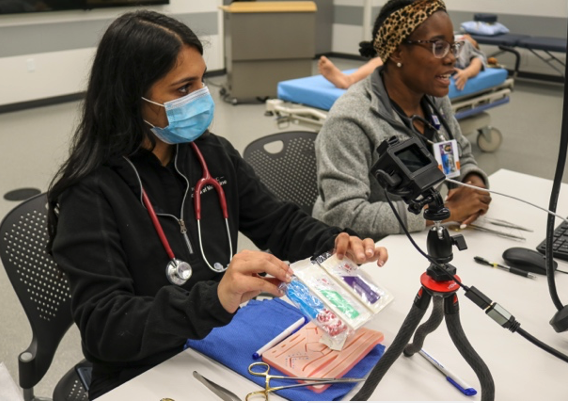
During the virtual Mini Medical School program, the young women were given suturing kits and were able to follow along in a suturing exercise with TCU and UNTHSC School of Medicine medical students, Juhi Shah and Briana Collins.
As part of the program the young women were also able to hear stories from Bianka Soria-Olmos, M.D., pediatrician at Cook Children’s and Maria Manriquez, M.D., FACOG, Professor Department of Obstetrics & Gynecology at University of Arizona College of Medicine Phoenix about their journeys to medicine.
FORT WORTH – When medical students at the TCU and UNTHSC School of Medicine begin Phase 2 of their medical education, they get the opportunity to experience inpatient immersions that will orient them to hospital environments, help them understand their role on a care team and help them learn how to care for acutely ill patients.
Several of those sessions took place in the medical school’s Simulation and Technology lab that is led by Kevin Kunkler, M.D., executive director, simulation, education, innovation and research professor at TCU and UNTHSC School of Medicine.
“We wanted to make sure that they had a basic foundation for things like knot tying and for suturing in case they had the opportunity to do it when they were on their clinical rotations,” Dr. Kunkler said.
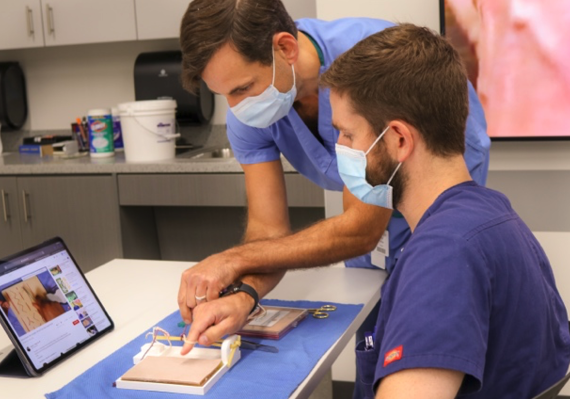
In one of those sessions, the medical students learned how to suture open wounds using life-like chunks of simulated skin that were created by Dr. Kunkler and his team. They also were able to get some help in creating a solid tray for the skin to sit in utilizing 3-D printing technology from the TCU Library team.
“They have several different 3-D printers over at their facility and we needed something like a tray to be able to fit the skin in,” Dr. Kunkler said.
Using that 3-D printed base to stabilize the skin, the medical students were able to learn how to perform two important types of knots – the two-hand knot tie and the one-hand knot tie.
“Depending on what situations they are in, you use a two-hand knot tie, which is really the traditional tie,” said Dr. Kunkler. “There are some situations where you are in the abdomen or you’re trying to go deep into the wound and that second hand almost kind of gets in the way. So, you’ll have to do what is known as a one-handed tying technique as well.”
The medical students also had sessions on properly caring for newborns and infants, performing CPR, getting properly dressed in personal protective equipment (PPE) and much more prior to their inpatient immersions that include rotations in Internal Medicine; Obstetrics and Gynecology; Pediatrics; and Surgery clerkships throughout the Dallas-Fort Worth area.
“I’m feeling excited I’m feeling inspired by all of the people that are around me and just really powerful,” said Alejandra Gutierrez, a first-year medical student at TCU and UNTHSC School of Medicine.
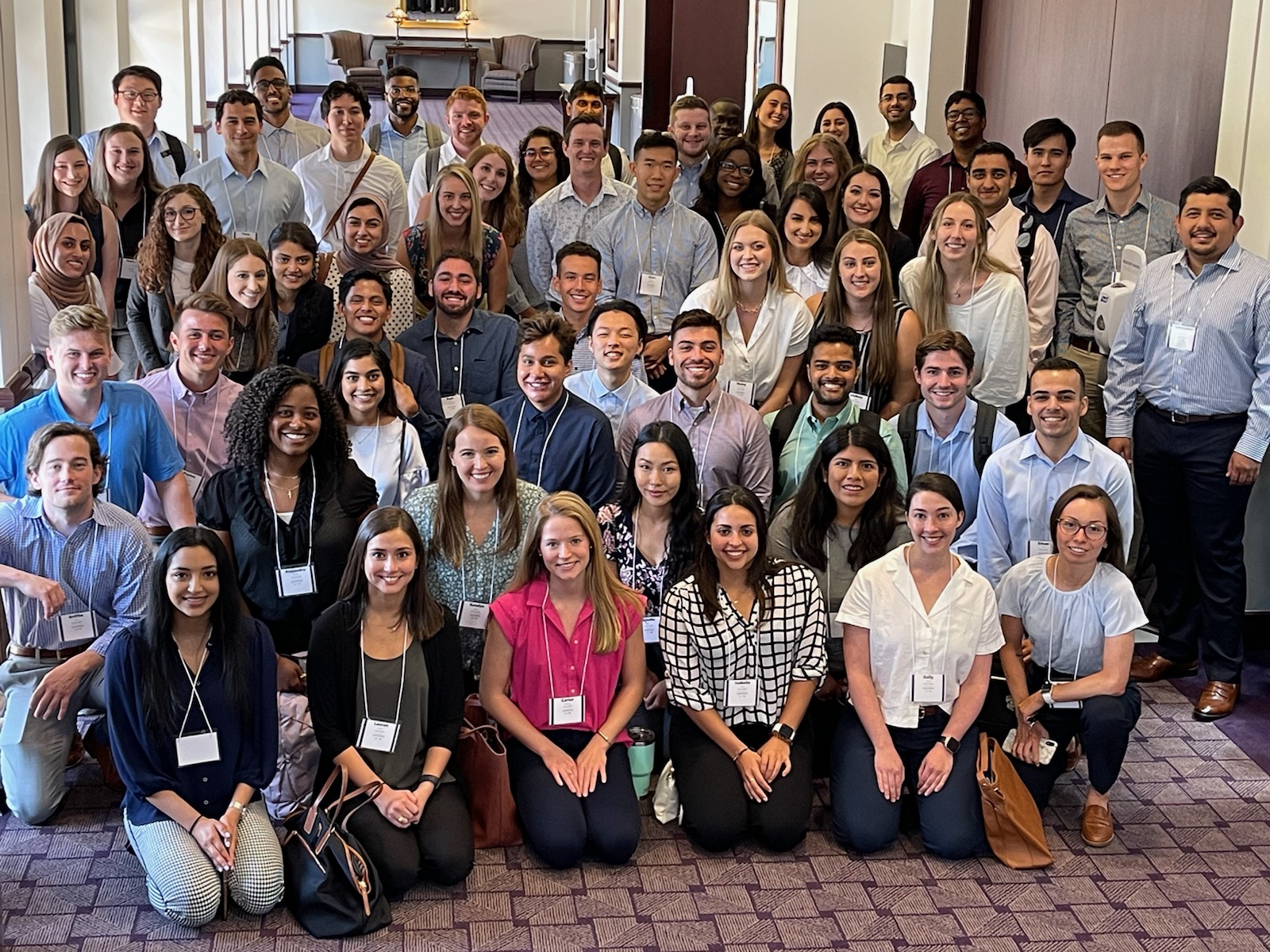
The group began their day with a one-on-one session with Stuart D. Flynn, M.D., the founding dean of the medical school. Then, they were ushered into the TCU Brown-Lupton University Union where they had the chance to mingle and have their TCU Identification photos taken.
“I told them that they are going to work. That we are in this together and to take care of themselves and find time for themselves,” Flynn said. “That message of taking care of yourself was never spoken back in the day and by back in the day I mean even 20 years ago. I had a mentor who actually helped me in that regard. I think we need to pass that on through the generations and we need to prevent things that happen to people when they get exhausted and they are struggling to function.”
That message of being mindful of taking care of their own mental health as they make their journey through medical school resonated with first-year student Christopher Corona.
“Because that’s just as important as learning medicine,” Corona said. “I thought it was really awesome of him to stress that as far as our medical education is concerned.”
The smiles and energy from the medical students were shared by the Office of Admissions & Enrollment Services. This was also the first time the team was able to meet the cohort of students in person due to the COVID-19 pandemic.
“After having our entire virtual application season and also Second Look Weekend and on-boarding pre-matriculation it was really exciting to have them here in person,” said Erin Nelson, Psy.D., Assistant Dean of Admissions & Enrollment Services.
As the temperatures in North Texas hovered around the mid-90s throughout the day, the students were able to cool off in the shade with some free Kona Ice treats before taking a self-guided tour of TCU’s campus.
Kevin Chao, a first-year medical student and one of 13 TCU graduates in the Class of 2025, led a few groups on tours of the campus he’s called home for the past four years.
“Everybody was standing around wondering how are going to do a self-guided tour and I was like well I did four years here,” Chao said. “We toured the (TCU) Rec Center, we toured the (Mary Couts Burnett) Library, we went to the science buildings and I was giving them all the little tidbits about the school, which is kind of fun.”
They also had a jam-packed day of orientation at the UNT Health Science Center campus where they went through Med SafeZones training. This training is designed to introduce faculty, staff and medical students to the identities and experiences of lesbian, gay, bisexual, and transgender, and queer (LGBTQ+) people and to increase awareness and knowledge of health disparities experienced in the LGBTQ+ community.
Following that session, the students were able to have their headshots taken and pick up some gifts along with more frozen treats, this time from Steel City Pops, to beat the North Texas heat.
The new medical students also got the chance to meet the two other classes at Pinstripes in the Clearfork neighborhood in Southwest Fort Worth.
“This will be the first time ever that all of the students in all of the classes get to meet one another all in the same place live and in person,” said Dr. Nelson.
This was an opportunity to meet in-person and begin to build camaraderie between the classes of medical students and also hand down some wisdom, according to Dilan Shah, a third-year medical student.
“So far what I’ve talked to the new MS-1s about is our LIC curriculum and I’ve also been asking them what specialty they are interested in,” Shah said. “I think it’s really cool to contrast what you come into medical school thinking you know what you want to do and then you get halfway through and see what you end up doing.”
Chao heeded Shah’s advice as they mingled between the bowling lanes at Pinstripes.
“They said take this month in as much as you can,” Chao said. “Take all the initiation and introductory things and relax because it’s going to ramping up pretty soon.”
The Class of 2025 also had the opportunity to mingle with faculty and staff, Class of 2024 and Class of 2023 during an Ice Cream Social.
That set the stage for the Learning Communities reveal during a Facebook Live event.
The event introduces the incoming medical students to their Learning Communities and their Physician Development Coaches. It’s all a part of the THRIVE wellness curriculum that is a longitudinal, integrated and collaborative system of instruction, learning and support for the medical students to focus on their well-being.
“Looking at how we can support medical students and specifically their mental health and well-being across is front and center is certainly a core pillar for us here at the school of medicine,” said Danika Franks, M.D., Assistant Dean of Student Affairs.
The students closed Welcome Week with Frog Camp at TCU and a picnic where each class of medical students could eat, socialize and play games with each other to build camaraderie.
“Just reflecting on the last class. The second-year medical students who didn’t get the opportunity to do this Welcome Week last year helps me appreciate it that much more,” said James Okpamen, a first-year medical student. “Being able to meet the second- and third-year students and meet the faculty at all the Welcome Week events it just helps us feel more normal.”
“It was a tremendous opportunity for them to serve the community. We all agreed that it would be amazing to partner with Baylor Scott & White Health and allow some of the medical students to do the vaccinations,” said Danika Franks, M.D., assistant dean of Student Affairs at TCU and UNTHSC School of Medicine.
Every Saturday for 10 weekends, School of Medicine first- and second-year students made up half of the vaccinators at the drive-thru vaccination clinics, which administered 18,922 COVID-19 vaccines to Tarrant County residents over a span of 12 weeks. In all, 91 School of Medicine students — 75% of the two classes — participated in the vaccination clinics.
“Our students forthright and outright are amazing servant leaders. We see it in our admissions process. Service is one of the top items of discussion, whether they are asking us about opportunities to serve or whether they are sharing about how they have already served. It infiltrates into the students we select and what they want to do during their time here at the School of Medicine,” Franks said.
TCU and UNTHSC School of Medicine students are always primed and ready to serve. Through the School of Medicine’s Learning Communities, students regularly volunteer in Fort Worth’s North Side, Diamond Hill, Como, Eastside and Stop Six communities.
“Even apart from this vaccination effort, they are constantly serving within those communities. So this was just a very natural conduit in terms in how they are wired as individuals as well as who we are and what we believe in the School of Medicine. Our curriculum really focuses on compassion and empathy,” Franks said.
Behind the scenes, a Student Affairs logistical planning group met weekly to ensure there were 18 School of Medicine student vaccinators as well as ample faculty volunteers to supervise each vaccination clinic.
On the curricular side, Kevin Kunkler, M.D., executive director for simulation education, innovation and research at the School of Medicine, led the student training effort. After completing a training module, students had to demonstrate their expertise in being able to administer the intramuscular injection.
“I want to commend the group who stepped up to the plate and took their job descriptions further by giving extra hours. There were well over 90 hours that this group contributed to making this successful on top of what they already do at the School of Medicine, and I think that is just an amazing example of how committed both our curriculum and Student Affairs teams are to being part of our local community and to helping our students be successful in their service to Fort Worth,” Franks said.
“The students represented our school to our community with strength, accuracy and compassion in a time that is truly unprecedented. I know they will never forget this. This kind of service will be something they look back on and will shape the future of their careers. I’m obviously very proud of who they are as students,” Franks said.
The bonding experience from the effort will long be felt by students, faculty and staff.
“Anytime you roll your sleeves up and serve together, the type of bonds you form as a team are things hard to simulate in any other environment. I think this experience helped students realize how much of an impact they can have. It also helped to further their identities as professionals in training. For our School of Medicine faculty and staff, it has contributed to our ability to recognize the impact we have beyond the day in and day out work in Student Affairs or training within the curriculum and to see how that directly impacts the communities we live in. There’s no better way to improve the dynamics of teamwork, trust and camaraderie than to do work together side by side,” Franks said.
The vaccination effort also demonstrated TCU’s long-standing commitment to the Fort Worth and Tarrant County communities.
“Obviously TCU is an excellent place to be trained and educated and to grow as a professional in many different arenas, but I think this also helped the community to remember TCU’s deep commitment to the overall Fort Worth and Tarrant County area by serving in a profound way during a very unprecedented time during the pandemic,” Franks said.
TCU and UNTHSC School of Medicine COVID-19 vaccination drive volunteers
Student Vaccinators:
AJ Agana, Aya Al-Adli, Arsalan Ali, Amber Broderick, McKenna Chalman, Hermen Charrez-Baxcajay, Kathryn Biddle, Sarah Cheema, Briana Collins, Shanice Cox, Shawn Cudworth, Emma DiFiore, Alleyna Dougherty, Caden Duffy, Noah Embry, Dakota Endsley, Sam Evans, Navid Farahani, Karena Fassett, Christopher Fernandes, Arman Fijany, Sam Fink, Sam Finkenstaedt, Kassidy Fretz, Madeleine Gallagher, Vandana Garg, Coltin Gerhart, Kashmeera Giga, Amber Hawkins, Jack Healy, KJ Herbert, Mary Howerton, Joe Hoyle, Antonio Igbokidi, Benjamin Jacobs, Nikki Jamieson, Alec Jessen, Sereena Jivraj, Kavneet Kaur, Madeline Keane, Faria Khimani, Areeba Khwaja, Charna Kinard, Michael Kranz, Jonas Kruse, Henri Levy, Quinn Losefsky, Ryan Lucker, Sarah Lyon, Ali Mahfuz, Brandon Mallory, Zachary Miles, Paige Miller, Will Mitchell, Lauren Moore, Alina Moroz, Amir Mostafavi, Krithi Narimetla, Hira Nazim, Grace Newell, Yolancee Nguyen, Suju Ojha, Matthew Pagano, Sarah Person, Rachel Rice, Leticia Rivera, Connor Rodriguez, Adam Rosencrans, Tom Roser, Meaghan Rousset, Danielle Sadler, Nathalie Scherer, Dilan Shah, Juhi Shah, Anne Shirley Hoselton, Kyle Simon, Josiah Snowden, Rebecca Sobolewski, Alex Tolman, Prema Vyas, Alexandra Waller, Shelby Wildish, Sophie Wix, Adam Wolf, Ariel Woods, Ilana Zago and Daniel Zeter.
Vaccination Clinic SOM Student Leaders:
Edmundo Esparza, Sam Evans, Lauren Moore and Sarah Person
Faculty Volunteers:
Danika Franks, Debra Atkisson, Mike Bernas, Jennifer Coffman, Chase Crossno, Jim Cox, Tom Deas, Layla Edwards, Linh Ho, Ken Hopper, Collin O’Hara, Steve Scott, Frank Sloan, Hanna Smitherman and Emily Todd.
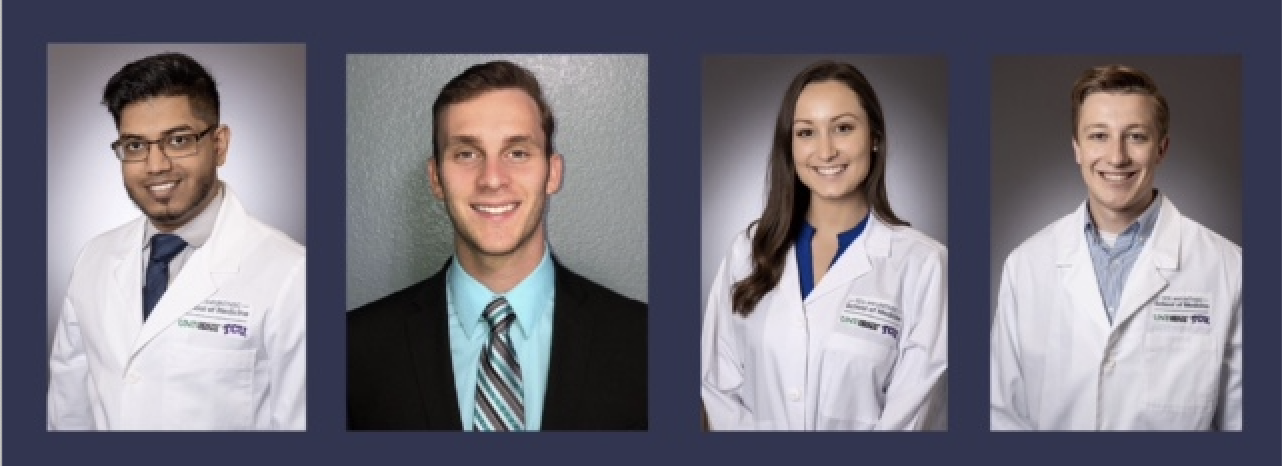
Mafuz was part of an investigation team led by NYU Long Island School of Medicine researcher, Morgan R. Peltier, PhD., an associate professor in the Departments of Clinical Obstetrics, Gynecology, and Reproductive Medicine at NYU Long Island School of Medicine, part of NYU Langone Health. The study found that most of the pregnant women who participated in the study had detectable levels of PBDEs in their blood.
The study showed that women with concentrations above 4 nanograms per milliliter of blood were about twice as likely to birth their children earlier through a cesarean section or intentionally induced labor because of safety concerns for the mother or infant. In comparison, women that had PBDE levels below that level showed no elevated risk for preterm birth.
First-year medical student Noah Embry assisted a Plano-based orthopedic surgeon in preparing a case study on the fastest recovery time in pediatric tibial tubercle avulsion fracture repair using the speedbridge double-row technique. The case report was published in Journal of Orthopedic Surgery and Techniques.
The case report showed that while Tibial Tuberosity Avulsion Fractures (TTAF) account for less than 1% of pediatric fractures they usually occur in adolescent males and most often occur with jumping. Most techniques to repair the fracture require screws and a minimum of 3 months to heal. The new technique by Dr. Chris Miller of Legacy Orthopedics & Sports Medicine, uses an all-suture, double-row knotless repair technique without the need for screws, plates, or metal. It helps patients move into the postoperative state without casting, faster range of motion, immediate therapy and a quicker return to playing sports.
Second-year medical student Jonas Kruse was a part of a group who presented an abstract paper at the American Academy of Neurology’s Annual Meeting on April 17, 2021.
Second-year medical student Mallory Thompson joined a group that had their study on COVID-19 and dermatological personal protective equipment considerations published on Taylor & Francis Online.
The study looked at the effect that cutaneous injury and irritation among health care workers had considerably increased during the COVID-19 pandemic. Hours of prolonged use of personal protective equipment (PPE) led to itching, pain and aggravation of underlying skin conditions in healthcare professionals during the height of the pandemic.
The study looked at specific PPE design and use to determine the dermatologic consequences of prolonged use of certain PPE items. The group aimed to improve current recommendations to prevent and address PPE-induced dermatologic conditions.
TCU and UNTHSC School of Medicine’s FWMD LIVE chat celebrated Pride Month by holding a discussion on how better communication can reduce health disparities for the LGBTQIA+ community.
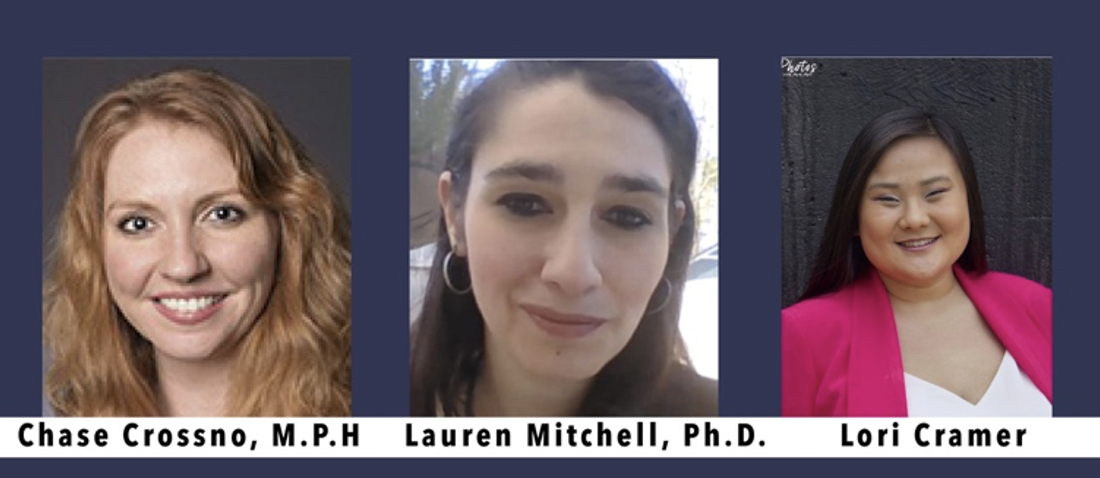
The guest panelists were faculty members Chase Crossno, M.P.H., assistant artistic director and associate professor; and Lauren Mitchell, Ph.D., assistant professor and director of narrative medicine as well as Lori Cramer, co-founder of the SafeZone Initiative.
They discussed how important it is for physicians to be trained to be culturally competent to provide better care for the LGBTQIA+ community and why organizations such as the SafeZones Initiative can be instrumental in helping local communities and workplaces become more inclusive.
You can watch the full discussion below.
Here some links with more information on communications skills to help support the LGBTQIA+ community.
FORT WORTH — TCU and UNTHSC School of Medicine’s FWMD LIVE chat welcomed two of America’s most prominent African-American women in activism and medicine to discuss the importance of Juneteenth and health care disparities facing African Americans.
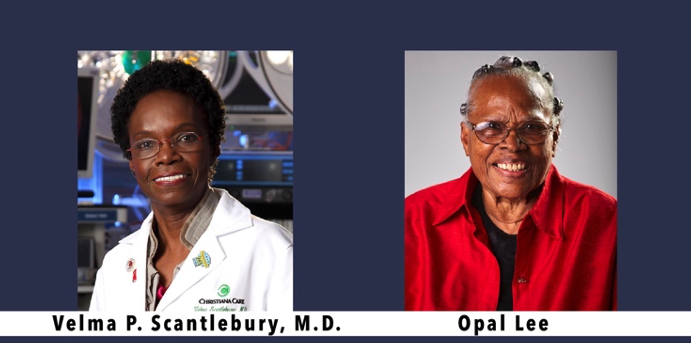
The guest panelists were SOM visiting professor Velma P. Scantlebury, M.D., the nation’s first African-American female transplant surgeon, and Opal Lee, 94, Fort Worth’s Grandmother of Juneteenth. Her petition to U.S. lawmakers to make Juneteenth a national holiday has garnered more than 1.5 million signatures. Each year, she walks 2.5 miles, which represents the number of years it took before the Emancipation Proclamation was enforced in Texas.
They discussed the U.S. Senate’s resolution to unanimously establish June 19 Juneteenth National Independence Day as a U.S. holiday and steps African Americans can take to reduce health care disparities in their communities.
You can watch the full discussion below.
Here some links with more information on Opal Lee’s Juneteenth celebrations and information about health care disparities facing African Americans in the U.S.
“This is a tremendous step in solidifying the medical school’s role as a critical partner in making Fort Worth and North Texas a place where medical innovation in education and health care occurs,” said Stuart D. Flynn, M.D. the medical school’s founding dean. “We are extremely humbled and grateful that the LCME favorably assessed our training mission to graduate physicians who will deliver compassionate care and lead into the rapidly changing health care environment, despite their not being able to visit our campus in-person due to the COVID-19 pandemic.”
Members of the LCME voted at their meeting in mid-June to grant Provisional Accreditation to the innovative medical school that focuses on inspiring future physicians as Empathetic Scholars ®. A team of accreditors from the LCME met virtually with senior leadership, faculty and students during a virtual site visit in February before making their Provisional Accreditation decision.
H. Paul Dorman, chairman and CEO of Fort Worth-based DFB Pharmaceuticals, generously donated the cost of tuition for the first year of class for the inaugural class in 2019, who are known as the Dorman Scholars. Recently, an anonymous donor couple funded tuition for the 2021-22 academic year for the entire class of 60 students at the School of Medicine that began medical school in July 2020.
“We are extremely thankful for the support from our community members in helping us build a new model of medical education in Fort Worth,” said Dean Flynn. “Their support has given our medical students comfort in decreasing their cost to attend medical school and allows them to fully immerse themselves into their training. This is positive for our students, our community, and ultimately for the patients our graduates will serve.”
The innovative curriculum at the School of Medicine focuses both on developing Empathetic Scholars®, physicians able to “walk in a patient’s shoes with compassion” while embracing and leading major drivers in the future of medicine, including artificial intelligence, technology monitoring patient health and disease, and genomics. Each student also does a four year research thesis, nurturing life-long inquiry and learning.
To date, 120 of our students have attended classes on TCU and UNTHSC campuses and participated in patient care with our affiliates in Fort Worth and North Texas. Addressing the COVID-19 pandemic the students, faculty and staff at the medical school supported the Fort Worth-Dallas region in numerous ways including the Fort Worth PPE Drive, Virtual Blood Drive, Back-to-School Drive, children’s book reading projectand more.
In February 2020, Baylor Scott & White All Saints Medical Center Fort Worth and the TCU and UNTHSC School of Medicine announced their collaboration on starting a new Accreditation Council for Graduate Medical Education (ACGME)-accredited physician resident training program. The collaboration, that will eventually train more than 150 physicians annually, will not only improve health and the delivery of care in North Texas, it will also address the ever increasing physician shortage in Fort Worth and beyond.
Texas Christian University and the University of North Texas Health Science Center formed a unique private-public partnership to form this new allopathic medical school in July 2015. The medical school will prepare students to be compassionate physicians, excellent caregivers and prepared to meet the challenges of the rapid advances in medicine. By 2030, the annual economic impact of the medical school is estimated at $4 billion, and the school is expected to generate about 31,000 jobs for North Texas, according to a Tripp Umbach study.
Learn more about the TCU and UNTHSC School of Medicine using the links below.