As a rookie police officer in 2001, a car crashed into Schechterle’s patrol car causing it to burst into flames, trapping him inside. He suffered severe burns to more than 40 percent of his body, which drastically altered his appearance.
He credits his survival to first responders and physicians who acted within the first few minutes and hours of his patrol car bursting into flames.
“These students will have their own adversity in life like everyone does but they will also be taking on other people’s adversity,” Schechterle said.
As Schechterle showed images of himself on the operating table following the accident, students reacted in shock.
Jenna Williamson, MS-1 at Burnett School of Medicine, gasped and wiped tears from her eyes.
“I’ve never been in a situation like his but I can empathize with him,” Williamson said. “I appreciated that he was willing to go so deep it made it so much more real.”
Schechterle has undergone more than 50 surgeries just to have the ability to accomplish simple daily tasks most people take for granted. His story was eye-opening to Bjorn Bjornsson, MS-1 at Burnett School of Medicine at TCU.
“That was one of the most impactful speaking engagements that I’ve ever been too,” Bjornsson said. “It’s definitely not something that I think I’ll ever forget.”
During their first year, the students will begin each week with a content framing session. A patient will share their story about a disease or medical complication that is related to their learning objectives for the week, according to Erin Nelson, PsyD, Assistant Dean of Physician Communication at Burnett School of Medicine.
“We pick the patients very intentionally,” Dr. Nelson said. “The idea is when you’re trying to memorize these complicated things you can think back and say I met someone on Monday and they told me what it felt like.”
Schechterle returned to the police force 18 months after his accident and went on to become a homicide detective. He turned his tragedy into a positive force for others with a similar experience.
He carried the Olympic Torch in the 2002 Salt Lake City Winter Games. His book, ‘Burning Shield,’ has given him the opportunity to speak to audiences around the world.
To talk with medical students at the beginning of their medical school journey is rewarding to Schechterle: “To talk to them when they’re so eager to begin is fun for me.”
“I worked as a public health microbiologist in California. I helped during the COVID-19 pandemic and realized that some communities were more impacted than others. That motivated me to want to work on the clinical side and provide care. I wanted to help address those issues and that’s what motivated me to become a doctor.”
Why did you choose the Burnett School of Medicine at TCU?
“I chose Burnett School of Medicine at TCU because of the small class size. I wanted to have a close relationship with my professors. I also like the unique curriculum, it’s engaging, and I walk away from a class session feeling like I’ve learned so much.”
What’s one thing your classmates don’t know about you?
“I love to sing, and I’ve actually done a few performances here and there over the years; nothing big or major. Maybe, I’ll find myself on the stage again.”
What’s next for you in your medical journey?
“I am looking forward to transitioning into rotations and getting more exposure to different medical disciplines. I’m interested in internal medicine but will also explore other fields to see if I have any other interests.”
The two-week Introduction to Medicine curriculum at the Burnett School of Medicine at TCU emphasizes a patient-centered approach through communication.
The communication training was a deciding factor in choosing the medical school, said Sereen Osman, MS-1 at Burnett School of Medicine and a Fort Worth native: “This environment is really going to nurture me to grow into the type of physician I want to be.”
Communication training for Burnett School of Medicine students has always been a core piece of the Empathetic Scholar® curriculum. The Physician Communication team has taken it a step further for new medical students by adding more communication sessions during Introduction to Medicine, according to Jo Anna Leuck, M.D., Senior Associate Dean for Academic Affairs at Burnett School of Medicine.
This starts with students learning to putting an emphasis on well-being and centering themselves before meeting with patients.
In one of their first sessions together as a class, the medical students began their day in silence.
“I wasn’t expecting to do full meditation techniques,” Osman said. “I really did appreciate it because it shows the school’s dedication to our general well-being.”
The 50-minute session on Mindfulness and the Art of Healing was led by Mark Dennis, Ph.D., Professor of East Asian Religions and Director of the Calm Studies group at TCU’s AddRan College of Liberal Arts. The students also took part in a Brain Health session designed to help them understand the important role communication plays in maintaining their overall health and wellness.
“It’s not just focusing all on academic success but also managing our stress levels and preventing burnout,” Osman said.
It’s important to give the students these tools before they get overwhelmed, Dr. Leuck added.
“We’re trying to build Empathetic Scholars®, and we want to get them started on the right foot,” Dr. Leuck said. “These are foundational things students need before they get started in the curriculum.”
INTRODUCTION TO MEDICINE
The unique Introduction to Medicine course explores the flipped classroom and active learning model, exam skills, Longitudinal Integrated Clerkship (LIC), along with Physician Communication and wellness. The students also learn about different student resources at TCU.
“This is different from most medical schools in the country,” Dr. Leuck said. “We don’t have an orientation or welcome week; we’ve actually made this a course.”
The students also learn the three phases of curriculum, which is different from the traditional academic year model. Phase 1 is 15 months where students learn the integrated foundations of basic and clinical sciences.
Along with incorporating the school’s White Coat Celebration, the course emphasizes the “why” behind this fresh approach to medical education that foregoes lecture-based classrooms.
“I feel like most medical schools would jump right into the lecture portion of it,” said Bjorn Bjornsson, MS-1 at Burnett School of Medicine.
Bjornsson grew up in Iceland and majored in Biochemistry at UCLA as an undergraduate. He said the course gave him a chance to connect with his classmates and faculty at the medical school.
“I went to a big school for undergrad and I felt lost in the masses,” Bjornsson said. “Coming here is a totally different vibe and there’s communal support.”
PHYSICIAN COMMUNICATION
As part of Physician Communication training, students started the day with a card game.
“We’re doing active learning and they presented us with the science and facts of why it will make us better,” said Haya Qaddura, MS-1 at Burnett School of Medicine.
The students randomly selected cards from a deck and placed the cards on their foreheads. They were placed into groups of 12 and told to create a hierarchy for their group based on the cards. No one knew what was on their card, however, they needed to figure out what was on the card based on interactions. What started off as fun quickly became a more reflective exercise.
“It was teaching us how to work as a team,” Qaddura said.
The exercise was meant to give clarity and conviction to how important communication is in a hospital setting, according to Erin Nelson, Psy.D., Assistant Dean of Physician Communication at Burnett School of Medicine.
“Communication isn’t merely a soft skill, it’s clinical,” Dr. Nelson said. “The curriculum is built to teach listening, presence and emotional intelligence.”
RELATIONSHIP-BASED COMMUNICATION
Communication is a huge factor in determining whether patients are satisfied with their physicians, according to a study by National Institutes of Health (NIH).
Students come into these communication sessions learning how to ask patients prevalent questions in the clinical setting, Dr. Leuck said.
The class of 2029 participated in the Academy of Communication in Healthcare (ACH)-Relationship-Based Communication training. The students took part in interactive learning in groups of six.Each exercise had a problem-based scenario involving each student role-playing as a physician and later as a patient. The goal was simple — respond to the patient with empathy.
“I felt like this was a safe space to practice and get authentic feedback from both the instructor and my peers in real time,” Osman said.
Students also did exercises in relationship-centered communication, relational systems theory, skills adapted for leadership, non-violent communication and personal awareness.
“The communication training really humanizes medicine,” Qaddura said.
“The role of a doctor is really special because it includes the research and mentally stimulating side as well as the humanism side. You have to be there for patients on some of their most important days, and the combination of those really drove me to the role of a physician.”
Why did you choose the Burnett School of Medicine at TCU?
“I liked the small class sizes and how personalized the education is, as well as the focus on Empathetic Scholars®, that was something that was really important to me.”
What’s one thing your classmates don’t know about you?
“I know how to juggle. I learned how to juggle in undergrad with one of my friends because we thought it would be a fun hobby. “
What’s next for you in your medical journey?
“I’m attending pediatric residency at the University of Colorado in Denver. It was my first choice, so I’m really excited about what the future holds.”
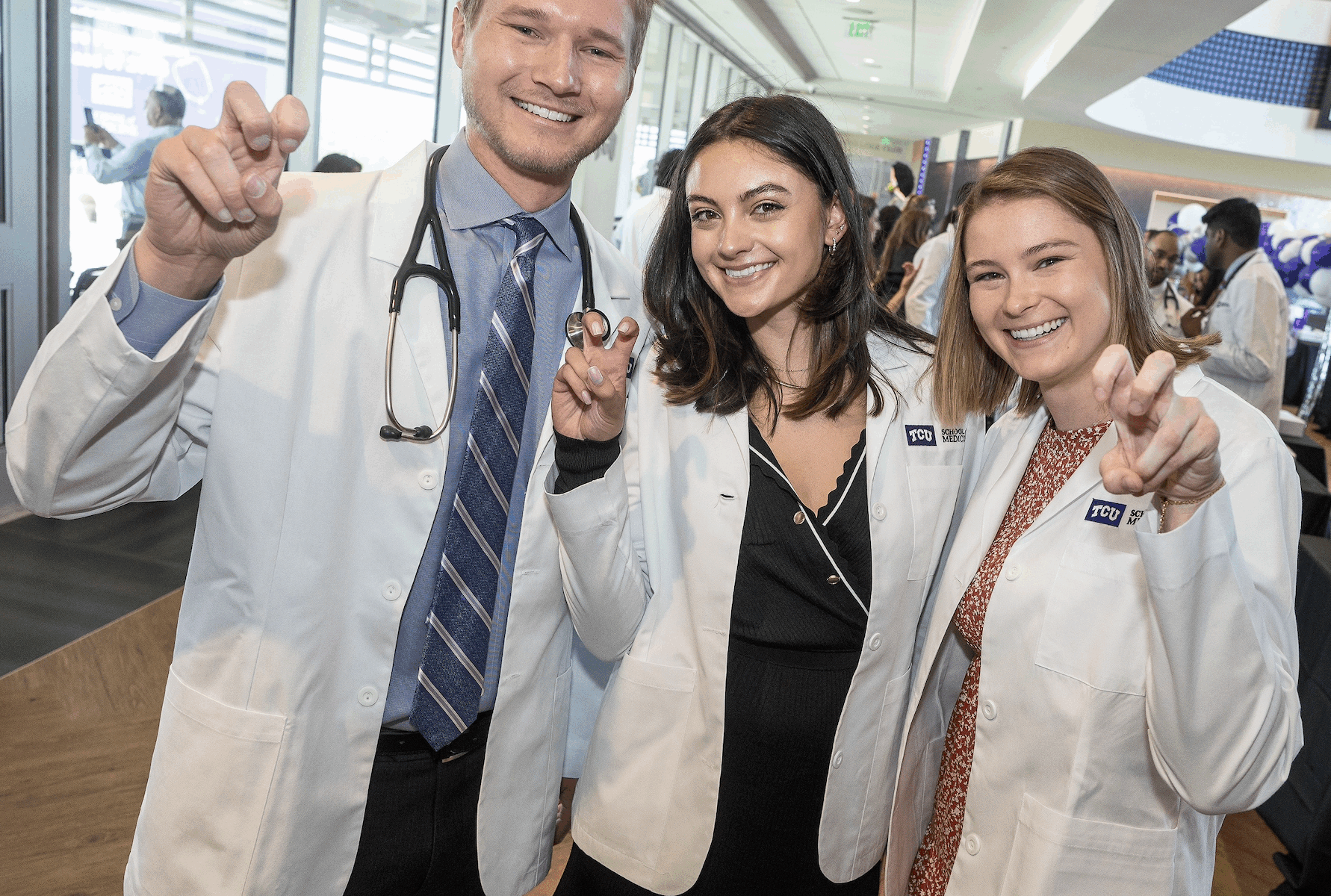
FORT WORTH – Sixty new medical students began their medical school journey at the Anne Burnett Marion School of Medicine at Texas Christian University and received their short white coats during the White Coat Celebration
The students received their white coats at TCU’s Legends Club at Amon G. Carter Stadium.
“This group of medical students is beginning their journey into medicine where their unique skillset of medical knowledge, empathy and technological training will be needed more than ever for future patients and communities,” said Stuart D. Flynn, M.D., Founding Dean of the Burnett School of Medicine at TCU. “This group will be in the center of Fort Worth’s Medical Innovation District (MID), where they can learn alongside our clinical partners and make an immediate impact on patient care in our community.”
Every year, white coat ceremonies are held by medical schools across the United States, and medical students receive their short white coats. This milestone signifies the beginning of their journey to achieve the long white coat, which they receive when becomingphysicians after completing medical school, according to the American Medical Association.
Being a doctor is a life’s work, Floyd Wormley, Jr. Ph.D., TCU Provost and Vice Chancellor for Academic Affairs, told the crowd in attendance.
“A doctor’s task is all about discovery, and at TCU, we emphasize the importance of innovation and life-long learning,” Provost Wormley said. “You will encounter many challenges on your journey, and you have the opportunity to discover solutions to vexing problems.”
There were 6,273 applicants who applied to be one of 60 students selected for the Burnett School of Medicine at TCU’s class of 2029, according to Kevin Kidder, Ph.D., Assistant Dean of Admissions at the medical school.
“We first met them all on paper, and we are so proud to have this wonderful group of future physicians starting their journey with us,” Dr. Kidder said.
The first-year medical students represent 19 states, with 11 from Texas. There are also 10 students who graduated from TCU. The class has an average GPA of 3.81 with 31 different areas of undergraduate study, including biochemistry, music, biomedical science, neuroscience, psychobiology, public health and molecular genetics and biology. Seven earned graduate degrees.
Aubri Robinson, MS1 at the Burnett School of Medicine, was selected by her peers to speak at the White Coat Celebration. She told the crowd that entering the medical profession takes courage.
“Be gentle with yourself,” Robinson said. “This coat is a privilege made possible by others’ sacrifices and entrusted to us. We already sense the goodness and love of this cohort, staff and school. Let’s carry that forward, especially in the hard moments.”
The first-year medical students began their studies with the Burnett School of Medicine’s Introduction to Medicine curriculum. The two-week course introduces them to the unique Empathetic Scholar® curriculum that emphasizeslife-long learning and a professional development mindset.
The White Coat Celebration takes place midway through the Introduction to Medicine curriculum and is a distinctive event compared with the traditional white coat ceremony. Foregoing the traditional model where new medical students have their short white coat put on them by school leadership, the Burnett School of Medicine celebrates the student and loved ones, according to Jo Anna Leuck, M.D., Senior Associate Dean for Academic Affairs at the Burnett School of Medicine.
“It’s one of my favorite things about this school,” Dr. Leuck said. “You get to open up a box with your white coat, and the people around you who were a part of your journey to get to medical school can participate in the celebration.”
The new medical students will get their first deep dive into the curriculum on Monday, July 14, with a content framing session and patient story from retired Phoenix police officer Jason Schechterle.
“My cousin Zachery was diagnosed with Dup15q; it’s a duplication of the 15th chromosome. My aunt and uncle had to go see specialists and the world of medicine opened up for me by hearing their stories. I thought it would be so rewarding to be a physician to help families like my aunt and uncle.”
Why did you choose the Burnett School of Medicine at TCU?
“I loved the early clinical exposure, but I also wanted a small class size. I really wanted to know all my classmates and I wanted to know students from other classes. I think that adds to your medical school experience.”
What’s one thing your classmates don’t know about you?
“I love to travel. I feel privileged to have seen so much of the world. I’ve been to thirty countries. One of first memories is going to Portugal with my parents to see my great-grandmother when I was 3-years old. Because traveling was instilled in me at such a young age, it’s something that I continue to do.”
What’s next for you in your medical journey?
“I matched my number one choice at Stanford Health Care in Pediatrics. I am in Palo Alto training at the Lucile Packard Children’s Hospital. I am so excited to be training with some of the top pediatricians in the country.”
“I’ve been in clinic so much recently so it was great to be able to come back and touch base with home,” said Nicolas Martinez, MS2 at Burnett School of Medicine at TCU.
Burnett School of Medicine students, faculty, and staff celebrated the one-year anniversary of Arnold Hall in late June. The celebration was also a good way for Martinez and other students to reconnect with faculty and staff at the medical school.
“It’s awesome because it reminds us that there are really people here for us,” Martinez said.
The celebration also served as the students, faculty and staff first chance to view the newly installed Journey sculpture anchoring the greenspace lawn at Arnold Hall. The sculpture symbolically celebrates life-long learning as a pathway and portal. It inspires reflection on the educational journey of a future physician and their patient. The sculpture serves as a testament to “patients as individuals” being the center of the educational experience, and that each engagement is always with a person, not the disease.
The medical school brought in food trucks from Frios gourmet frozen pops and Mexican soul food from Salsa Limon for the celebration. There was also a foosball table, a cornhole game, and Jenga set up outside. Inside the building, there was line dancing and a cake walk where students, faculty, and staff could win homemade cookies, brownies and cakes.
Iza Zabaneh, MS2 at Burnett School of Medicine, heard about the cake walk all morning in class before the celebration. He walked away from the celebration with a homemade Texas Sheet Cake.
“There were people more excited than me about the cake walk,” Zabaneh said. “Then of course I just casually walked in and won the cake. I hadn’t tried one before today but I will say it was a 10 out of 10 for sure.”
Linbeck construction broke ground on the 95,000-square-foot medical education building in Fort Worth’s Medical Innovation District (MID) in August 2022. Construction was completed in June 2024. The building boasts innovative technology and education spaces to train future physicians.
“I’ve been here when it was just steel beams and now there’s a foundation and there’s this community that’s always here for us,” Martinez said.
In September 2024, Arnold Hall was named in honor of Ashley and Greg Arnold of Dallas, Texas, for their generous philanthropic support of TCU and the Burnett School of Medicine. The medical education building serves as the hub for 240 medical students along with hundreds of faculty and staff.
One of Martinez’s favorite spaces in Arnold Hall are the classrooms that line the halls of the first floor. The cutting-edge classrooms are multi-faceted in their use for studying or group-based learning. They all have expansive whiteboards, video conferencing, and internet capabilities.
“I like to draw things out and make it colorful,” Martinez said. “I can take up as much space as I want too because there’s so much area for everyone to utilize.”
“I was shy when I was younger and scared to talk to others, and someone who made me feel safe was my pediatrician. Outside of my family, it was hard to talk to people, but she made me feel normal and loved. As a college athlete I always worked on teams, and I think medicine was the perfect calling because it combines hard work and creating a safe space for my patients.”
Why did you choose the Burnett School of Medicine at TCU?
“Burnett School of Medicine at TCU really aligned with everything I was passionate about and what I wanted to receive out of medical school. I was very interested in the Empathetic Scholar® program because that’s the reason I went into medicine in the first place.”
What’s one thing your classmates don’t know about you?
“I’ve played volleyball since I was in 4th grade. In high school, I played for the Swedish Junior Volleyball Nationals. I scored in 4th place in the country because I am also Swedish.”
What’s next for you in your medical journey?
“I matched at UC-Davis in Sacramento, California and I will be training to be a head and neck surgeon. Otolaryngology is what I’m most passionate about. You work with anything from the collarbone up and it greatly impacts how we can communicate with other people. I want to make people feel safe and supported.”
On June 23, the fire originated in the complex’s HVAC system, causing severe smoke damage that is still being assessed. The Cooper, located across from the Burnett School of Medicine’s Arnold Hall in Fort Worth’s Medical Innovation District, was home to many of our students.
We all know how difficult medical school is, and facing this additional challenge is devastating. Not only losing their housing, some of our students have lost many of their belongings and are faced with the challenges of finding new living arrangements, needing basic supplies such as linens and clothing, and replacing cherished belongings.
TCU immediately engaged and is providing temporary housing for our students and the medical school will provide additional assistance to get them back on their feet. Some students have renter’s insurance, and the Red Cross also is available for some basic supplies. As a School of Medicine that is focused on empathy and compassion, many of you already have reached out asking how to help support our students. We have set up a Frog Funding page to allow you to donate to our Student Emergency Fund.
If you would like to help students with a donation through Frog Funding, please click here. We will ensure that affected students have access for funds for immediate needs, such as food, clothing and basic items, as well as longer term needs such as deposit and rent assistance. Your gift to the Student Emergency Fund will move through an established process of oversight and equitable distribution to those in need.
Thank you for considering support to our students in need.
About Student Emergency Fund
Students may face challenges and hardships during their four-year journey through medical school. To help address needs of an extreme and immediate nature, the Burnett School of Medicine established and operates a Student Emergency Fund. The fund is designed to support students who experience “a short-term and unexpected funding need in order to address critical necessities that are impacting their medical school experience.”
“I wanted to use my hands and help my neighbors and people around me. I wanted something challenging. I knew I wanted to do medicine when I came back from a missions trip and I was so energized, so I knew medicine was for me.”
Why did you choose the Burnett School of Medicine at TCU?
“I wanted to go to a place that was new and innovative. I wanted to go somewhere that got me in the clinics early and out of the classroom early and had something eye popping to set me up well for the future. I’m very happy to have gone here and feel I’ve grown in my empathy in the clinical setting and have enjoyed getting out and practicing medicine early.”
What’s one thing your classmates don’t know about you?
“I was a swimmer for TCU. I got into swimming because I was terrible at every other sport. I worked really hard and enjoyed my four years competing and created a lot of memories and grew as a person.”
What’s next for you in your medical journey?
“I am off to Vanderbilt to start my Emergency Medicine residency. I’m stoked to go to Nashville and couldn’t be more excited to live out my dream.”