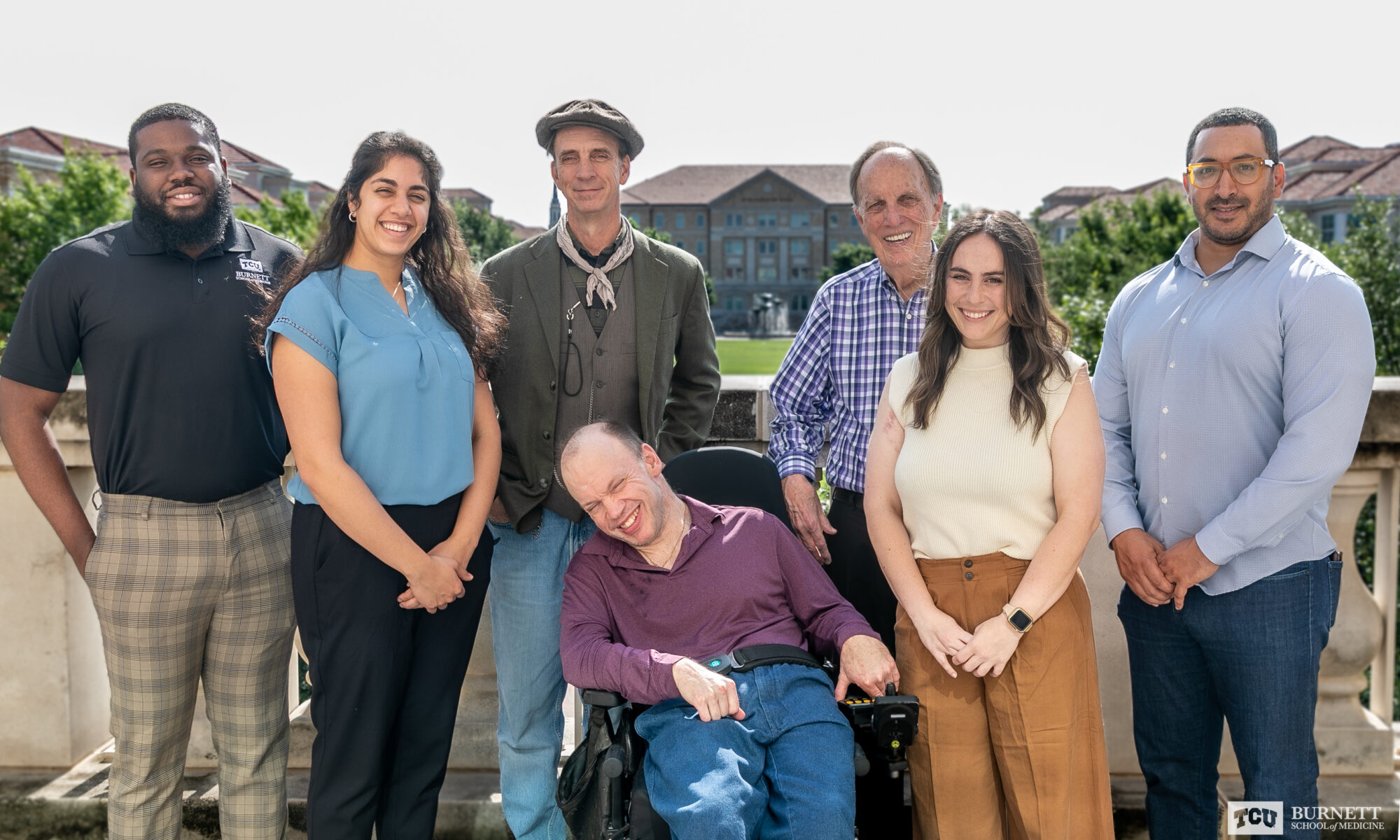
Graduating students in the class of 2024 at the Anne Burnett Marion School of Medicine at Texas Christian University presented their four-year Scholarly Pursuit and Thesis projects to faculty, staff and students. Watch a video here.
Graduating medical students in the class of 2024 at the Anne Burnett Marion School of Medicine at Texas Christian University participated in a military commissioning ceremony at TCU. Watch a video here.
A few years ago, I was on a walk with my wife. Walks are where we often connect and have some of our “deep” talks. I was processing with her the tough time I was having. At the time, it seemed every area of my life was a challenge. Work was hard, kids were hard, all the things life was asking of me were hard. Life did not feel easy at that moment, and I just wanted to feel better. My wife would understand. She would empathize. She would “make me” feel better. She didn’t. In retrospect, I think I expected my wife to respond with a “That sounds tough” and “Thanks for all that you do” and “How can I help?” Instead, she just said, “What if what you think is an obstacle is really an opportunity?”
What did I do? How’d I respond? I threw an adult temper tantrum in my head and then did what any good overthinker does, I did my own research, the kind where you try to prove the other person wrong. As I processed and researched, I found this idea that at least dates back to the Stoics, a philosophy founded in ancient Greece. Modern Stoic philosopher and writer Ryan Holiday shares that Marcus Aurelius, nearly 2,000 years ago, said “The impediment to action advances action. What stands in the way becomes the way.” To make this point concrete, Holiday shares the following story to bring to life this question of obstacle or opportunity:
There is an old Zen story about a king whose people had grown soft and entitled. Dissatisfied with this state of affairs, he hoped to teach them a lesson. His plan was simple: He would place a large boulder in the middle of the main road, completely blocking entry into the city. He would then hide nearby and observe their reactions.
How would they respond? Would they band together to remove it? Or would they get discouraged, quit, and return home?
With growing disappointment, the king watched as subject after subject came to this impediment and turned away. Or, at best, tried halfheartedly before giving up. Many openly complained or cursed the king or fortune or bemoaned the inconvenience, but none managed to do anything about it.
After several days, a lone peasant came along on his way into town. He did not turn away. Instead, he strained and strained, trying to push it out of the way. Then an idea came to him: He scrambled into the nearby woods to find something he could use for leverage. Finally, he returned with a large branch he had crafted into a lever and deployed it to dislodge the massive rock from the road.
Beneath the rock were a purse of gold coins and a note from the king, which said:
“The obstacle in the path becomes the path. Never forget, within every obstacle is an opportunity to improve our condition.”
What are you facing today? Obstacles or opportunities? Maybe you have a challenging, strained relationship with a classmate, co-worker, or person in your life?Maybe you say obstacle. To what? To life being a little easier?Maybe you are being called to be more compassionate, understanding, tolerant or kind. Maybe this classmate, co-worker, or person in your life is acting inappropriately. While inappropriate behavior is not OK and never to be condoned, you still have an opportunity to realize an inner strength, to create and enforce personal boundaries, and to connect with people who support you and will work with you to make conditions better. Maybe you have a “late shift” or a “long” weekend of work. If you say obstacle, again, ask yourself “Obstacle to what?” Your expectations for the number, sequence, or timing of the days and times you are asked to work relative to time “off”? And what do you really want to do in your time off? Is “time off” really better? Would it really serve your higher self and your future development? If yes, then you have the opportunity to be very intentional with your time off. If you’re not sure, you also have the opportunity to serve someone in that work, to contribute to something greater than yourself, andto realize, again, inner strength, passion, and purpose. You also have the opportunity to decide whether this “work” is for you or not, and the opportunity to move your life and work in a different direction, one that better suits you.
This may sound callous, but here’s the compassionate truth: that’s just a perception. It was certainly my perception when I first heard it. But it wasn’t, it isn’t, callous. It’s loving. It’s recognizing that the way you see things is not the way things are, just how you are. It’s honoring that there may be so much more to you than you could have ever realized. You have, like I did, the opportunity to grow, to be more than you have ever been, to experience life as better than you can imagine, more fulfilling and meaningful in a greater variety of conditions.
I was recently talking with a very successful, tenured physician and medical educator about the challenges medical students face today. They said a common obstacle for struggling students is to realize that “medicine is not about them and their discomfort.” What is about you and your discomfort is knowing, and knowing what to do when you realize,that your discomfort is a signal to the opportunity for where and how you can grow.
Joseph Campbell said, “Where you stumble, there lies your treasure.” That day on our walk (and still to this day) my wife was ahead of me in her spiritual and personal journey. I knew that. So, I listened. Instead of continuing to question her, I realized I needed to question. What I found wasshe was giving me a gift, pointing me to my treasure, my opportunity. Over time, I felt so much better, better than a pat on the back, an “excused absence”, or someone else rescuing me ever would. And I felt better because my vision was better, because my perception of myself, things, others, andlife was better, because, as the Buddha said, “with our minds we create the world” and my mind was clearer, sharper, better, because I was capable of more than I realized because I could handle more, because I was more responsible, because the obstacle was the opportunity, the gift, the treasure.
If you are “still in process” or facing a challenge or tough time, heed the sage advice from the Stoics, the Zen masters, and all the current-day leaders who have been where you want to go, are doing what you want to do, and model who and how you want to be. I urge you to continually come back to this question, day in and day out: What lies before me, is it an obstacle or an opportunity? Come close. Here’s the secret. The answer is always opportunity.
The Spark Grant provides $1,000 in seed funding for innovative projects that have the potential to enhance the learning experience of medical students, trainees or faculty.
The grant also funded the development and implementation of the Clinical Skills cardiopulmonary escape room, which put students in a gamified scenario set in a fast-food restaurant.
As part of the award, the Clinical Skills team has been invited to present their findings at the SGEA regional conference in 2025. During the presentation, team members will share the results of pre-and-post surveys that students filled out that speaks to how effective the escape activity was.
“Just keeping the student’s attention is sometimes difficult,” said Sandra Esparza, M.D., Director of Clinical Skills at the Burnett School of Medicine at TCU. “This is a fun way for them to practice. They’re trying to be competitive with their classmates. So, it makes them think in a quick fashion, which is what medicine does.”
When awarding the Spark Grant to the Clinical Skills department, SGEA stated they believe this project has the potential to make a lasting impact on the medical education continuum.
The escape rooms are set up like your normal escape room, but it has a medical twist to it. Each clue has a medical scenario that must be solved to get to the next clue that will eventually solve the medical puzzle.
This gamification in medical education is having an impact on students. First-year medical student Marisa Fat sees the benefit of these escape room activities: “This one was really fun because it had a lot to do with medicine and it incorporated everything that we learned in class, and it was really engaging. I really enjoyed it.”
The Class of 2024 matched at prestigious health care systems such as The Mayo Clinic, UCLA Health, Duke University Medical Center, and UT Southwestern Medical Center in March and will continue the next phase of their medical careers as resident physicians.
Rebecca Sobolewski, M.D., a graduate of Burnett School of Medicine at TCU, is off to Vanderbilt University Medical Center in Nashville, Tennessee, as an Emergency Medicine resident. She’s learned more than medicine during her time at the medical school.
“I think what TCU has ingrained in me is that it’s not just about your studies. It’s not just about being an adequate physician. It’s also about being an empathetic physician,” Dr. Sobolewski said.
The Burnett School of Medicine opened in July 2019 with its inaugural class of medical students. The medical school’s unique curriculum with a focus on communication and the development of Empathetic Scholars® has uniquely positioned the school to radically transform medical education and improve health care for generations.
STUDENT SPOTLIGHTS
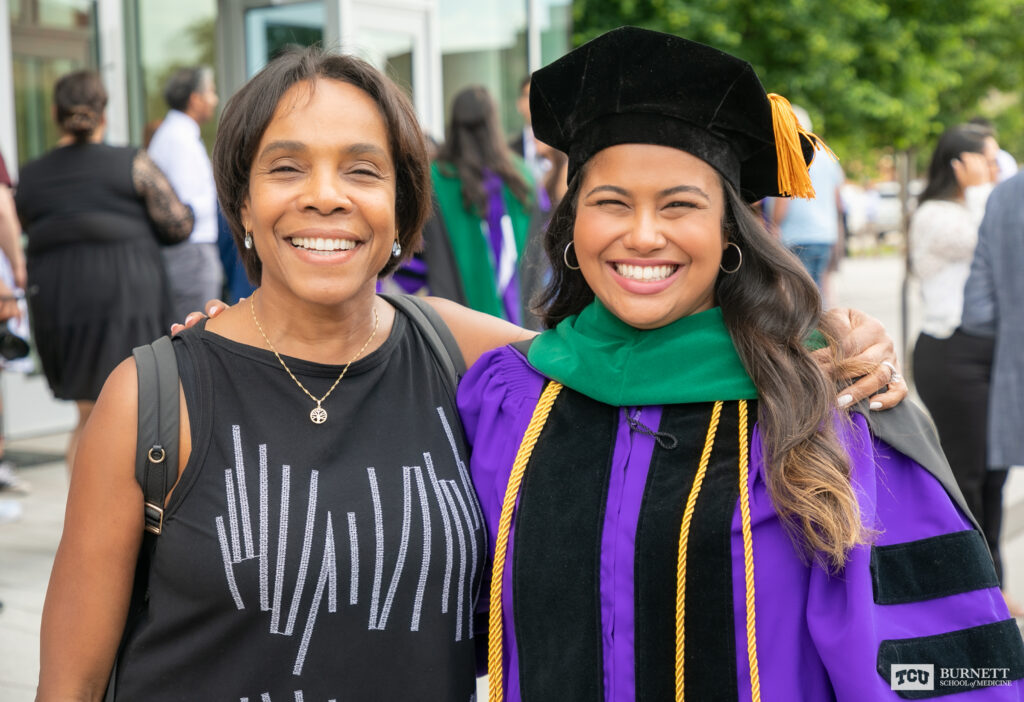
Ina Braniff, left, with her daughter, Rebecca Sobolewski, M.D.
Rebecca Sobolewski, M.D.
Hometown: Chicago, Illinois
Program: Vanderbilt University Medical Center
Specialty: Emergency Medicine
The West Side of Chicago, Illinois, is one of the cities three major sections that include the North Side and South Side. It’s the place that Rebecca Sobolewski, M.D., called home.
“For me, my big thing is community. My community raised me and got me where I am today,” Dr. Sobolewski said.
The West Side is made up of nine diverse neighborhoods, but it is also a place where its more than 480,000 residents experience high rates of chronic diseases such as diabetes, asthma, hypertension, and infant mortality rates far above the national average, according to West Side United a collaborative neighborhood organization.
Dr. Sobolewski’s mother, Ina Braniff, worked multiple jobs to make sure Rebecca and her sister Rachel could attend Chicago’s top primary schools.
“She did lots of random odd jobs to make ends meet,” Dr. Sobolewski said about her mother. “She worked for the airlines and did online interpreting and translating in her off hours.”
When she was around 3 years old, her mom gave her a toy stethoscope and a toddler-size white coat to pretend to be a doctor. Braniff was clear about her daughters’ future professions, Dr. Sobolewski said with a smile.
“She looked at me and my sister and said, ‘one of you is going to be a doctor and one of you is going to be a lawyer,” Dr. Sobolewski said. “My sister was much better at arguing. She took law and I took medicine. She lit that flame and made sure I was able to get the education I needed to get.”
To get there, both women would have to be the first in their family to graduate college, law school, and medical school.
“I wasn’t really surrounded by anybody in my family or anybody else who were physicians,” Dr. Sobolewski said.
It was a long road to get there for Dr. Sobolewski. Her sister would eventually become a lawyer before passing away from complications of epilepsy while Dr. Sobolewski was in medical school.
“It’s really difficult when you’re alone in it and you are kind of figuring everything out for the first time,” she said.
Once she arrived at Baylor University for her undergraduate studies, Dr. Sobolewski began to find support through her pre-medicine program. After graduating, she thought she would leave Texas to attend medical school closer to home, however, her interview at the Burnett School of Medicine changed her heart and mind.
“Every other medical school interview felt like you would be so lucky if we happen to choose you,” Dr. Sobolewski said. “But TCU made me feel like we would be so blessed to have you. That was the big difference for me.”
The Burnett School of Medicine supported her in all of her endeavors in the Fort Worth community and the Student National Medical Association (SNMA) while she studied medicine.
“If I was interested in it, I just had to talk to somebody and that was it. I had support for it,” Dr. Sobolewski said.
It was the extracurricular work she’d done throughout the community that made her stand out during residency interviews.
“The more I talked to people they said, ‘you’re not just a medical student you’ve built so many more identities outside of being a medical student that your application stands out,’” Dr. Sobolewski said.
Now, she wants to spend her career giving back to communities like the West Side of Chicago where she grew up.
As she begins her residency program at Vanderbilt University Medical Center this summer, Dr. Sobolewski views emergency medicine as the front door to health care for many communities.
“Being able to take care of their immediate needs and being the first face that they see is really special and dear to me,” Dr. Sobolewski said.
Sarah Person, M.D.
Sarah Person, M.D., with her husband Andrew Parson and daughter Kaitlyn Person.
Hometown: Arlington, Texas
Program: Texas Health Resources
Specialty: Internal Medicine
Sarah Person, M.D., was 9 years old when she picked out a white coat and stethoscope for her Halloween costume.
“My grandma got me a white coat and it had Dr. Sarah Powers [her maiden name] on it and I still have that white coat,” Dr. Person said. “I still remember how exciting that felt but I had no idea what that journey entailed.”
While her grandmother might have planted the seed, her desire to pursue medicine took shape in high school while her family lived in Beijing, China. She worked at a special needs orphanage where she met a physician that asked her to assist him checking babies. That enabled her to ask questions about patient care and ultimately solidified her decision to want to go to medical school.
“I just fell in love with understanding the science behind it,” Dr. Person said.
She moved back to the United States and attended Baylor University as an undergraduate before attending the Burnett School of Medicine.
A personal statement letter she wrote as freshman in college about why she would like to go to medical school had some core values that mirrored the core values of the Burnett School of Medicine.
“I remember reading the school’s mission statement and saying, ‘that’s the kind of medical school I want to go to because that’s the physician I want to be,’” Dr. Person said.
The medical school’s Physician Communication curriculum played a key role in her medical training prior to going on away rotations, she added.
“That communication piece set me apart,” Dr. Person said. “I think that is such a missed opportunity in some medical schools and our school spends so much time teaching us how to communicate.”
Christopher Fernandes, M.D.
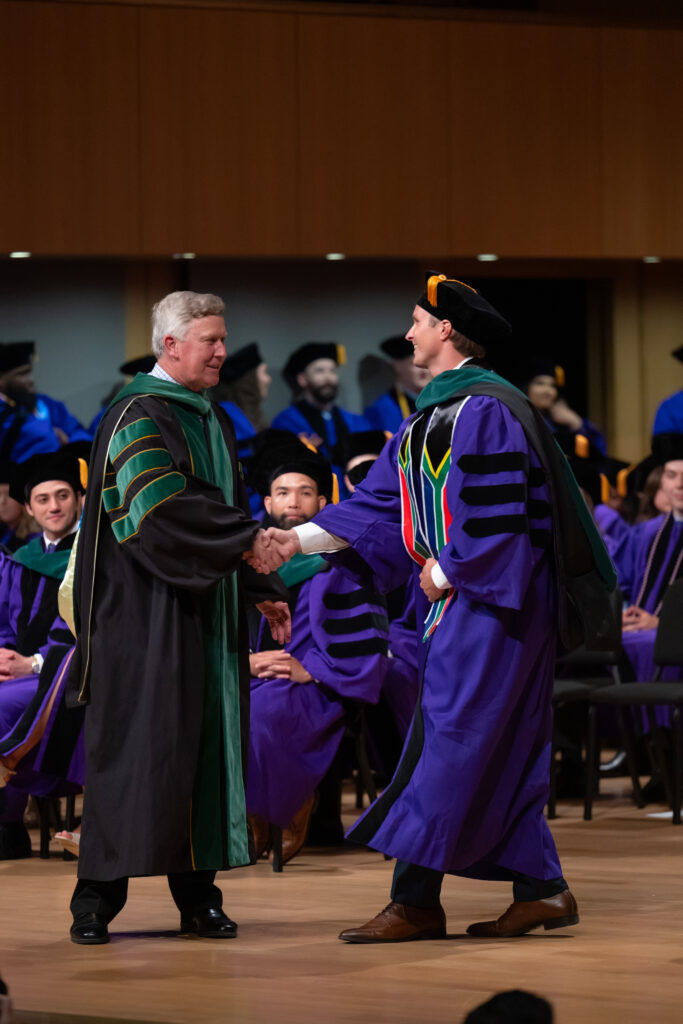
Christopher Fernandes, M.D., shakes the hand of Dean Stuart D. Flynn, M.D.
Hometown: Durban, South Africa
Program: Stanford Medicine
Specialty: Emergency Medicine
Surfing and riding waves off the coast of South Africa is where Christopher Fernandes, M.D., fell in love with the ocean. He thought he would be a professional surfer.
He grew up in Durban, a coastal city in eastern South Africa’s KwaZulu-Natal province, which has South Africa’s third largest population behind Johannesburg and Cape Town. He immigrated to the United States alone to pursue his surfing dreams while attending the University of California at San Diego where he competed nationally.
Little did he know that his “side hustle” as an Emergency Medical Technician (EMT) would lead to his future in medicine.
“I worked as an EMT for seven years,” Dr. Fernandes said. “During my EMT work, I really found fulfillment taking care of people and their stories and I wanted to be more involved in their care.”
Interestingly, there were qualities in surfing, such as being adaptive and resilient, that aligned with his newly found passion emergency medicine, Dr. Fernandes added.
“When you surf the ocean is always changing so you have to make decisions with little information,” Dr. Fernandes said. “That’s one of the things I found interesting about working in the emergency room.”
There were specific qualities he wanted in a medical school.
“When I worked with my patients one-on-one in the back of the ambulance or the emergency room, I really wanted that care and getting to know my patients,” Dr. Fernandes said. “My goal was really to make shared decisions with them and really put their health care first.”
The Burnett School of Medicine at TCU’s Empathetic Scholar® curriculum embodied all those qualities. The early and longitudinal clinical exposure in the eight major medical specialties each week gave him a broad scope of health care.
“If Monday was OB, Tuesday was Surgery, Wednesday was Emergency Medicine, so I think practicing all the skills and seeing the large breadth helped to develop the importance of practicing medicine wholly,” Dr. Fernandes said.
This summer, Dr. Fernandes will begin his Emergency Medicine residency at Stanford Medicine.
Nicole Jamieson, M.D.
L-R: James Marshall, M.D., Chair for Pediatrics; Nicole Jamieson, M.D., and Angela Cantrell, Ph.D., Chair for Medical Education
Hometown: Bakersfield, California
Program: Stanford Medicine – Stanford Pediatrics Residency
Specialty: Pediatrics
What do you want to be when you grow up? It’s the age-old question children hear from adults.
When Nicole Jamieson, M.D., was in sixth grade on the ride home from school, her mother asked that question.
“I said, ‘I don’t know. I think I want to be a doctor,” Dr. Jamieson said. “But it kind of seems like a lot of work and daunting.”
Her mom reassured her that she’d be a great doctor if she put her mind to it, Dr. Jamieson added.
“Ever since that moment that’s all I wanted to be,” Dr. Jamieson said.
She completed her undergraduate studies in psychology and children’s research at University of Texas at Austin before coming to the Burnett School of Medicine. She knew that working with children and understanding psychology was her passion before medical school, but she needed to find a focus.
What she wanted from her medical school experience was a chance to connect with patients. From the moment she interviewed at the Burnett School of Medicine, she knew it was a place that could mold her into the type of physician she wanted to be.
“Their mission of the Empathetic Scholar® was just so pronounced and everyone was seeming to walk the walk,” Dr. Jamieson said. “That was something I never wanted to lose sight of as a physician. You’re not just treating patients; you’re treating people with a whole life outside the moment that you’re seeing them in.”
Through the Longitudinal Integrated Clerkship (LIC) curriculum, Dr. Jamieson found her focus in pediatrics. The early clinical exposure set her up for success during her away rotations, which led to her match at Stanford Medicine, she said.
“By the time we got to the end of our third year and our fourth year, all of us were comfortable in the clinical environment,” Dr. Jamieson said. “The longitudinal relationship that I had with patients and my mentors really helped develop my skills overall.”
Caden Duffy, M.D.
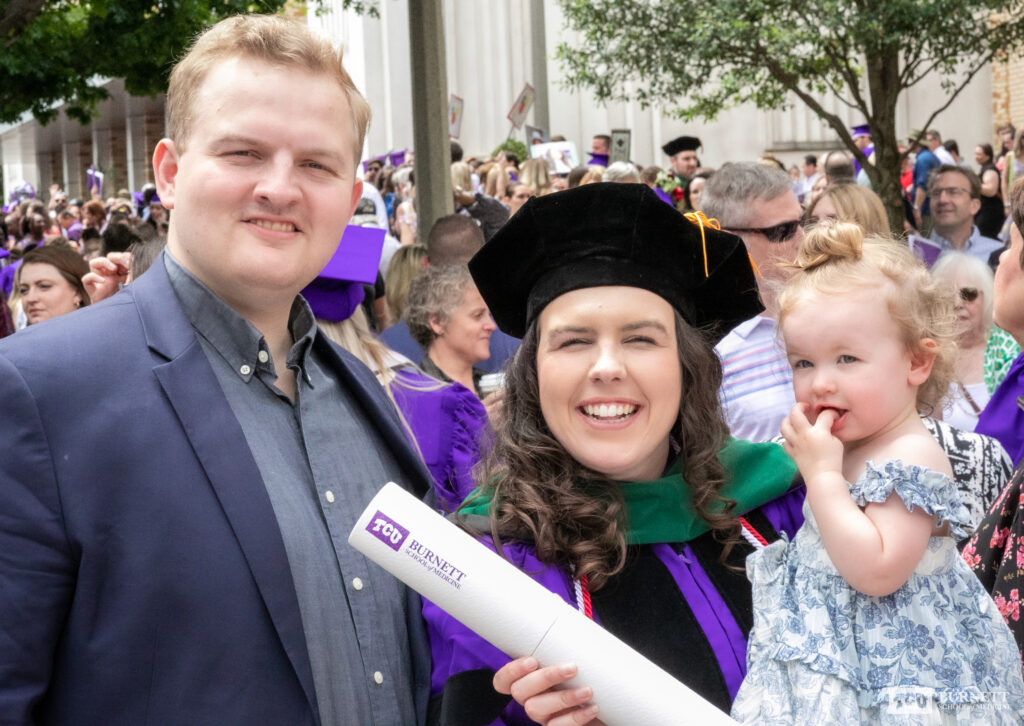
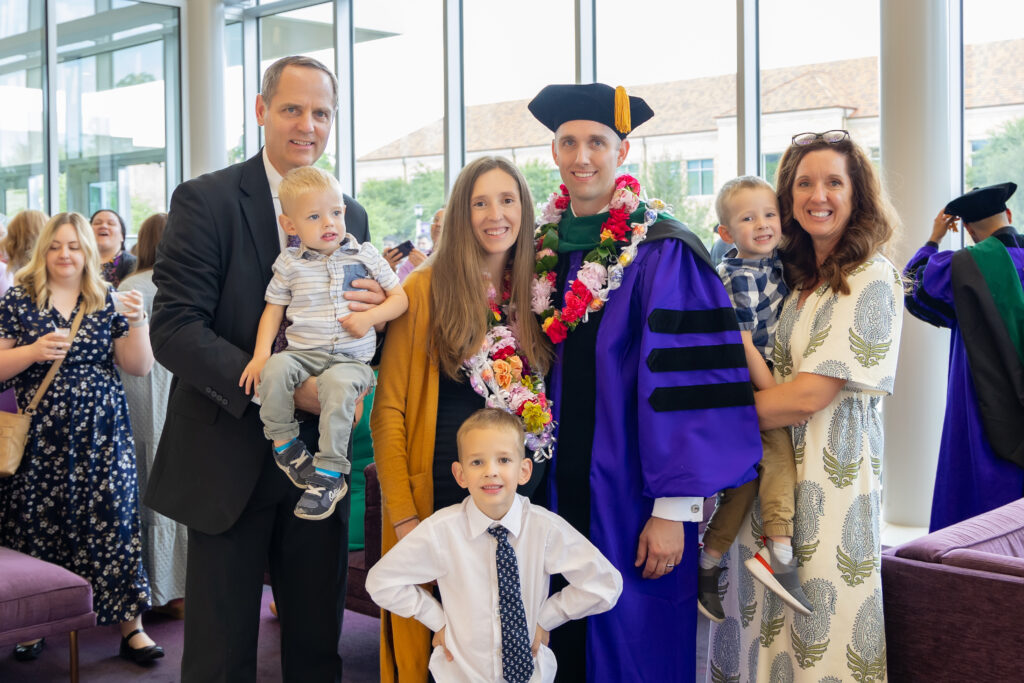
Caden Duffy, M.D., (center in regalia) with his family members.
Hometown: Salt Lake City, Utah
Program: University of Iowa Health Care
Specialty: Otolaryngology
The road to becoming a physician can take many forms and for some making a pivot during their undergraduate education can happen.
“I actually always wanted to be an engineer growing up,” Caden Duffy, M.D., said. “I was thinking mechanical engineer or chemical engineer for a while.”
His love for science didn’t blossom until his sophomore year at Brigham Young University. He participated at a free clinic in Provo, Utah, which has a large Spanish-speaking population. He was fluent in Spanish, so he was able to help translate for patients. Those interactions are what led to his medical journey as a physician.
“That’s when I felt like I really had a connection with the patients I felt like that was something I wanted to do with the rest of my life,” Duffy said.
Following that experience, he went back to that clinic for about four hours every Thursday night until graduation. After taking two gap years doing medical research, he made the choice to attend the Burnett School of Medicine at TCU. His decision to attend had a lot to with his previous experience working with Spanish speaking populations.
“That’s one of the things I was excited about moving down here to Texas and there’s an even higher percentage of Spanish speaking populations,” Dr. Duffy said.
He credits the Burnett School of Medicine’s LIC curriculum and extended clinical exposure with giving him the tools to connect with patients and attending physicians during away rotations.
“I felt like I was able to make great relationships with those attendings during the LIC and they were my biggest cheerleaders in helping me get to where I wanted to be,” Dr. Duffy said.
There were 123 participating Otolaryngology programs in the U.S. during the 2023-2024 Electronic Residency Application Service (ERAS) cycle, according to the American Association of Medical Colleges (AAMC). Residency spots differ per program. Some otolaryngology programs have 5-6 residents per year, while others may have 1-2 residents per year. The University of Iowa was his top ranked program for Match Day.
“That week for me was pins and needles because I had only applied to otolaryngology programs,” Dr. Duffy said. “I was so excited to have matched at my top ranked program.”
FORT WORTH – Students who started medical school during the COVID-19 pandemic received their hoods, signifying their successful completion of their M.D. program.
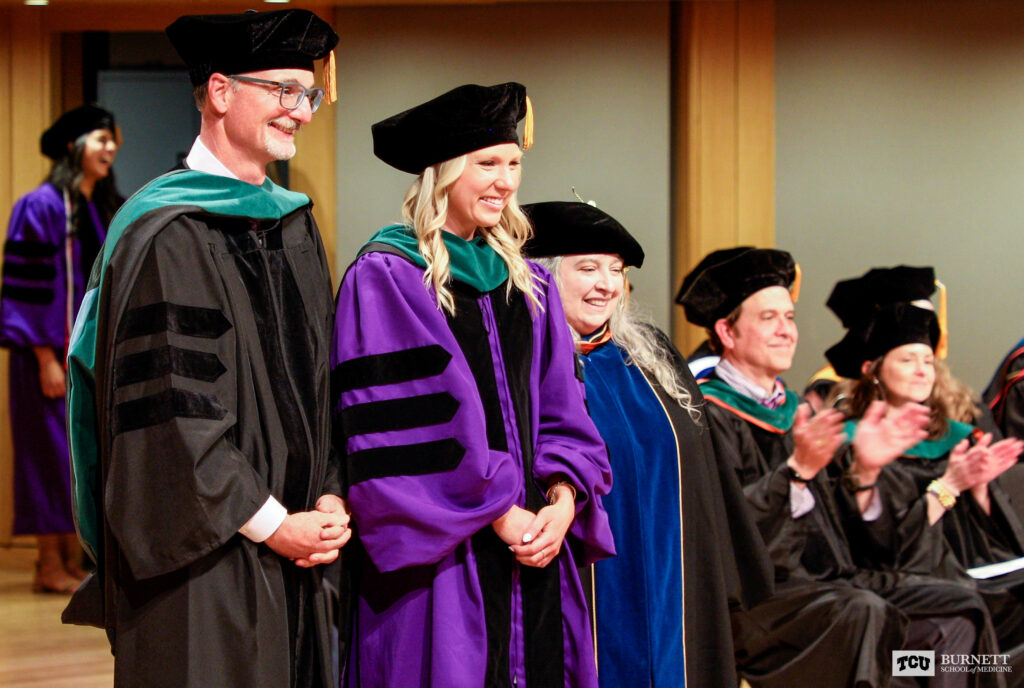
The Burnett School of Medicine at TCU’s second graduating class had the doctoral hood placed over their heads by department chairs from the medical school.
“The Hooding process symbolizes the culmination of our medical students’ training and represents their transition from student to becoming physician and colleague,” said Stuart D. Flynn, M.D., Founding Dean of Burnett School of Medicine at TCU. “We will follow their progress with pride and interest. They will embrace their futures as empathic scholars that are selfless in their care for others.”
Family and friends of the graduates filled TCU’s Van Cliburn Concert Hall on Friday, May 10.
TCU President Daniel J. Pullin, gave the charge to the graduates to believe in themselves and know that their contributions can make a difference.
“As you embark on your journey with residencies and future roles as attending physicians continue to innovate,” President Pullin said. “Advances in medicine are made by those who dream big with no boundaries and limits. Through your Scholarly Pursuit and Thesis (SPT) projects you’ve learned to answer to complex questions that aren’t always clear at the beginning. We have great confidence in you to make the world a better place and continue to improve how we take care of patients.”
The keynote speaker for the event was TCU Chancellor Victor J. Boschini Jr., who spoke about the joy of watching the graduates and faculty mentors on stage together in celebration of scholarly achievement and an academic tradition.
“The relationship between teacher and student symbolizes a unique connection that includes mentorship, intellectual growth and personal support,” Chancellor Boschini said. “As any student or professor will tell you – this relationship is mutually beneficial and enriches both parties’ lives. These connections happen across our campus every day and are what makes TCU unique.”
Antonio Igbokidi, M.D., addressed the crowd as one of eight students from his class inducted into the Burnett School of Medicine’s chapter of the Gold Humanism Honor Society (GHHS). The GHHS is a community of medical students, physicians, and other leaders who have been recognized for their compassionate care, which is essential for the health of patients and clinicians. The organization has more than 180 chapters in medical schools and residency programs and more than 45,000 members.
Igbokidi was selected by his classmates to speak at the Hooding Ceremony for being a true representation of an Empathetic Scholar®.
“Class of 2024, I’m inspired not just from the times when you delivered your first baby, aced exams, connected with the Fort Worth community, or your ability to hold your patient’s hand during their last moments of life and show them the upmost compassion,” Dr. Igbokidi said. “I am inspired by when others told you that you couldn’t that you did. I’m incredibly proud of who you all are. What you have overcome and no matter what people have said continue to reach for the impossible.”
The Hooding Ceremony is a traditional part of the yearly commencement celebrations. It dates to European universities in the 11th or 12th Century to differentiate students as they completed their academic careers. Graduates from the Burnett School of Medicine wore purple gowns with black velvet. The regalia also includes a Doctoral Tam, which is traditionally a soft tam.
The Doctoral Hood, worn around the neck and draping down the back, features the colors of the graduate’s university on the inside and the color of the academic discipline on the outside. For graduates of the Burnett School of Medicine, Kelly green (representing medicine) adorns the hood and the inside color was purple, representing TCU.
Throughout Asian American and Pacific Islander Heritage Month the Anne Burnett Marion School of Medicine at Texas Christian University will highlight some of its students, faculty and staff who will share the importance of celebrating the month and the importance of representation.
May is Asian American and Pacific Islander Heritage Month and is a time to reflect and celebrate the important role that Asian Americans, Native Hawaiians and Pacific Islanders have played in our shared history.
Throughout the month, we will be sharing stories and voices from our medical school and important historical figures throughout medicine.
Marisa Fat, MS1, Class of 2027, shares the importance of representation in medicine and for the community:
Ashley Kenney, MS1, Class of 2027, shares the importance of celebrating the month and representation:
May is Mental Health Awareness Month. Great! But what does that mean, really?
I’m a words guy. Yes, I talk and write too much, but that’s not my point. I mean that words matter. I had a teacher who used to say, “the clarity with which we define something determines its usefulness.” I couldn’t agree more. So, what do we mean when we say “mental health”?
Let’s start with health.
While I could dissect the bad and useless definitions of health, let’s jump to my favorite. According to the 1986 Ottawa Charter for Health Promotion, “Health is a resource for daily life, not the objective for living. Health is a positive concept emphasizing personal and social resources as well as physical capacities.”
Now, let’s add mental to that. Mental being that which is experienced in the mind, psychologically, and emotionally.
Mental health is a resource for daily life, not the objective for living. Mental health is a positive concept emphasizing personal and social resources as well as physical capacities.
Practically, this means
mental health is something to be cared for, built, and used as a resource
specifically, as a resource for your particular day-to-day life demands
these are inner and outer resources – grow yourself in ways, and a network of relationships, that make better your life and others’
it’s positive, so emphasize your strengths to build more strengths
your physical capacities – your vitality, physical health, energy, stamina, power, flexibility, and strength – are vital resources that when developed physically will manifest in the mind and in your life, too. Your mind and body are one.
Finally, the phrase and concept of “mental health”, especially mental illness, is often stigmatized; it’s been expressed as something worthy of disgrace and disapproval. Being understanding and helping people in a state of illness is not disgraceful, it’s compassionate, healthy, humane, and caring. More so, supporting people to know, accept, and care about and for themselves, realizing and relying on both the power of our inner and outer resources, strengths, and capacities, along with the ability to grow and develop them, and using that all in service of better living, is worthy of high praise, support, advocacy.
This month, support each other wherever you are and however you are, focus on what you have, what you can grow, and where you can go, and spread the positive word, experience, and meaning of mental health.
NEW ORLEANS – The buzz of hair clippers and the foot traffic of men, young and old, going in and out of Dennis Barbershop in New Orleans have been background noise to loud, and colorful, conversations for more than 60 years.
“You look good, you feel good. You feel good, you do good. That’s what we’re about,” says Barber Stan Norwood to about 20 Black men and their sons sitting in the shop as he cuts a patron’s hair.
Outside, a food truck is parked across the street with customers ordering plates to go. You can smell the creole seasonings and fried seafood in the air. Children are playfully walking home from school. This corridor of Freret Street in the historic Uptown New Orleans neighborhood is buzzing with vibrant colored and newly renovated businesses.
However, the modern construction surrounding the barbershop makes it look out of place. Its classic New Orleans shotgun-style building, red-white-and-blue barber’s pole and chipping white paint shows that the old building has weathered many storms. But the building adds character and charm to the street front. It’s sunny, breezy, and not a cloud in the sky. By New Orleans standards, the weather is perfect.
From the sidewalk you can hear Norwood’s baritone voice seeping through the creaky wooden walls of the barbershop. Inside, the mood is darker, serious, and much more intense.
His motivational speaking is part of a larger conversation about mental health for men of color. The focused look on the men’s faces as he speaks lets you know they are getting much more than a haircut on this Wednesday afternoon in late March.
“We just don’t go to a therapist we go to the barbershop, and this is a starting point,” Norwood said.
Oluwatomi Akingbola, a New Orleans native, is getting a haircut next to Norwood. The conversation among the guys weaved through such as self-confidence, mental health stigma, education, and Black men supporting other Black men. However, he remained quiet.
As his barber brushed the excess hair off him and removed the barber’s cape from around his neck, he stood up and interjected.
“For me, the thing I see in my community here in New Orleans as well as in Philly is we have a problem with gun violence,” Akingbola said. “What are we doing about it? What’s the root and the cause of it? Why are we killing each other in the streets? That’s something I want us to talk about in the barbershop too.”
There’s a slight pause of silence. Norwood scans the room and gestures to a wall in the corner with pictures of his clients, cluttered and pinned together. Many are photos of clients on obituary programs from funeral services.
“I’ve lost 33 clients over the course of my tenure of cutting hair,” Norwood said.
He’s been cutting hair at the barbershop since 2007. We can’t hide, he added.
“We’ve gotten to a point where we’re numb to it. It’s not like we should be like, ‘Damn they killed him too,’ ” Norwood said. “That’s now where I am.”
Medical Student On A Mission
The authenticity and raw emotions of this conversation is one of many similar conversations Antonio Igbokidi, MS-4 at Anne Burnett Marion School of Medicine at Texas Christian University, has been researching for four years.
Igbokidi, a native of Little Rock, Arkansas, who’s family is originally from Nigeria, arrived in Fort Worth at the Burnett School of Medicine at TCU during the COVID-19 Pandemic in July 2020.
Even with social-distancing measures in place, he wanted to look good and feel good for his first class of medical school.
“I wanted a haircut to look good through Zoom during the COVID times,” Igbokidi said with a smile.
He ventured out, with a mask, to find a barber. That action became the catalyst for his medical school research project, he would call the Barbershop Talk Therapy Project (BTTP).
Lake COMO House of Fades Barbershop in Fort Worth is where he heard frustration and pain being shared by men.
“They were complaining about feeling isolated, shame, guilt and all these different things with no outlet,” Igbokidi said.
After witnessing these conversations several times, Igbokidi thought the required Scholarly Pursuit & Thesis (SPT) research project at the medical school would be a great way to find a solution.
“The SPT program is really important to give the students a basic understanding of research and to get them involved with doing the research themselves,” said SPT Director Michael Bernas, M.S.
Igbokidi’s study asked if implementing therapy-led focus groups in barbershops, as community-driven safe spaces, could effectively contribute to improving mental health outcomes for minority males, particularly in underserved communities such as Fort Worth.
Another study published by the National Center for Health Statistics (NCHS) says that one in three men with daily feelings of anxiety or depression took medication for those feelings, and a little more than one-quarter talked to a mental health professional. Among men with daily feelings of anxiety or depression, 43% of non-Hispanic white men were more likely to have used either of these mental health treatments in comparison to 36% of non-Hispanic Black and Hispanic men.
Igbokidi had a personal interest in this project and psychiatry, which is a great starting point for research, Bernas said.
“That’s all part of research where you start from the very beginning with your question then work your way through to the analysis,” Bernas added.
For Igbokidi, the barbershop has an emotional connection. His father, who passed away, was normally reserved and quiet, but would engage in conversation at the barbershop.
“When I think about my childhood and my dad, he spoke a lot more at the barbershop than he did at home,” Igbokidi said.
His research project began with a virtual panel he put together with Fort Worth ISD Family Action Center and Burnett School of Medicine faculty physicians. He invited men of color from Fort Worth to join him via Zoom for a discussion about mental health. Once pandemic restrictions eased in 2021, Igbokidi found an ally who gave him a space to hold in-person discussions.
Igbokidi’s barber, Landter Goodrich, owner of Lake Como House of Fades Barbershop, was skeptical at first but understood Igbokidi’s heart and mind were in the right place.
“He said I’m doing this to bring men together and have a safe space to talk about things that we’re not normally able to talk about,” Goodrich said.
Igbokdi developed a 26-question electronic survey that gauged a participant’s knowledge and accessibility to mental health resources in Fort Worth. Through BTTP, Igbokidi provided free haircuts to barbershop patrons during a 2-to-4-hour open discussion with a mental health professional. In the beginning, only a handful of people showed up, but he still held the discussion with whoever came.
“He’s putting himself out there,” Goodrich said. “I decided to use my connections in the community to encourage more people to come out.”
Igbokidi also found collaborators to help him expand services at the events. The Black Owned Businesses (BOB) of DFW connected him with entrepreneurs who helped spread the word. The Black Heart Association collaborated with him to offer free health screenings. Medical students from the Burnett School of Medicine’s chapter of the Student National Medical Association (SNMA), which is the oldest black medical student organization in the United States, volunteered to help with health screenings.
A year later Igbokidi, dozens of men, young and old, showed up to events in Dallas, Arlington, and Fort Worth’s Historic Stop 6 and COMO communities. The men shared emotional stories about relationships, job loss, police brutality, and issues with the legal system. He even brought free haircuts and mental health discussions to Fort Worth’s unhoused population.
“It started with true collaboration with the community, and I think that’s why it’s worked out so well,” Igbokidi said.
He applied for grant-funding and received $10,000 from National Institute on Drug Abuse (NIDA) and $4,000 from the American Psychiatric Association (APA) to take the initiative nationwide while collecting data along the way. The funding covers the cost of the barbers’ services so patrons can get free haircuts during the mental health discussions.
He’s held barbershop events in Washington, D.C.; Hartford, Connecticut; and New Orleans so far. Going through the process gives students an appreciation for research, Bernas said.
“He started from zero,” Bernas said. “When you’re going out into the community and you’re having other people join you in your research and getting funding it’s wonderful.”
Dennis Sigur, who’s owned Dennis Barbershop in New Orleans for 46 years, opened his doors to Igbokidi for the event. He also had Rahn Kennedy Bailey, M.D., Chairman Department of Psychiatry at LSU School of Medicine, serve as the mental health professional to guide the discussion.
Casually dressed in a T-shirt and jeans, like he’s done in every BTTP discussion, Igbokidi stood in the center of the barbershop and introduced himself. He shared background about his research and opened the floor to the men to share whatever they might be feeling.
“This is a very good way to break the cycle and issue of stigma,” Dr. Bailey said. “If you have been exposed to trauma for example early in life and you don’t get a chance to address it professionally it may last the entirety of your life.”
“Mental health goes into that conversation [on gun violence]. I work at a Level One Trauma Center and we see gun violence almost every day,” Akingbola said. “Unfortunately, what you see is that it affects young Black men disproportionately. I kind of wanted to put that into the conversation as well if we’re going to keep it real.”
Keeping it real and being a listening ear for clients is important to Norwood.
“Although sometimes it’s a lot, I have to be that ear for them,” Norwood said. “If they have the sense of comfort to come in here and talk to us, we have to be that.”
‘We need more.’
Igbokidi will begin his Psychiatry residency at the UCLA Semel Institute for Neuroscience this summer.
He presented his research project at the American Psychiatric Association’s Annual Meeting in San Francisco. The 26-question survey he created was given to barbershop patrons voluntarily regardless of if they received a free haircut or not. He had more than 200 participants and about 100 surveys were completed.
Fifty-nine percent of people who took the survey believed their barber is like a therapist and talk to their barbers about sensitive topics they do not talk to anyone else about. Ninety-three percent of those surveyed felt more optimistic and less stressed after leaving the barbershop. Fifty-three percent said after attending a barbershop event, they probably or definitely would consider seeking a mental health provider. Fifty-seven percent felt more reassured about accessing mental health resources at the conclusion of the project.
Over the course of the research project, Igbokidi provided 500 free health screenings and 250 free haircuts. He plans to continue this initiative beyond medical school. This could be an opportunity for stakeholders and community leaders to make a difference, he said.
“What I keep hearing is we need more, we need more,” Igobokidi said. “Maybe this could be a platform and opportunity for us to spread to different parts of the country.”
Giving men of color across the country a space to freely discuss issues close to their hearts can make an impact. Igbokidi has done it for several years, so it shows sustainability, Dr. Bailey said.
“It’s heartwarming and his heart’s in the right place,” Dr. Bailey said. “It also points out that he is a young doctor going into psychiatry that understands what we do has as much impact on our communities as other areas of health care.”
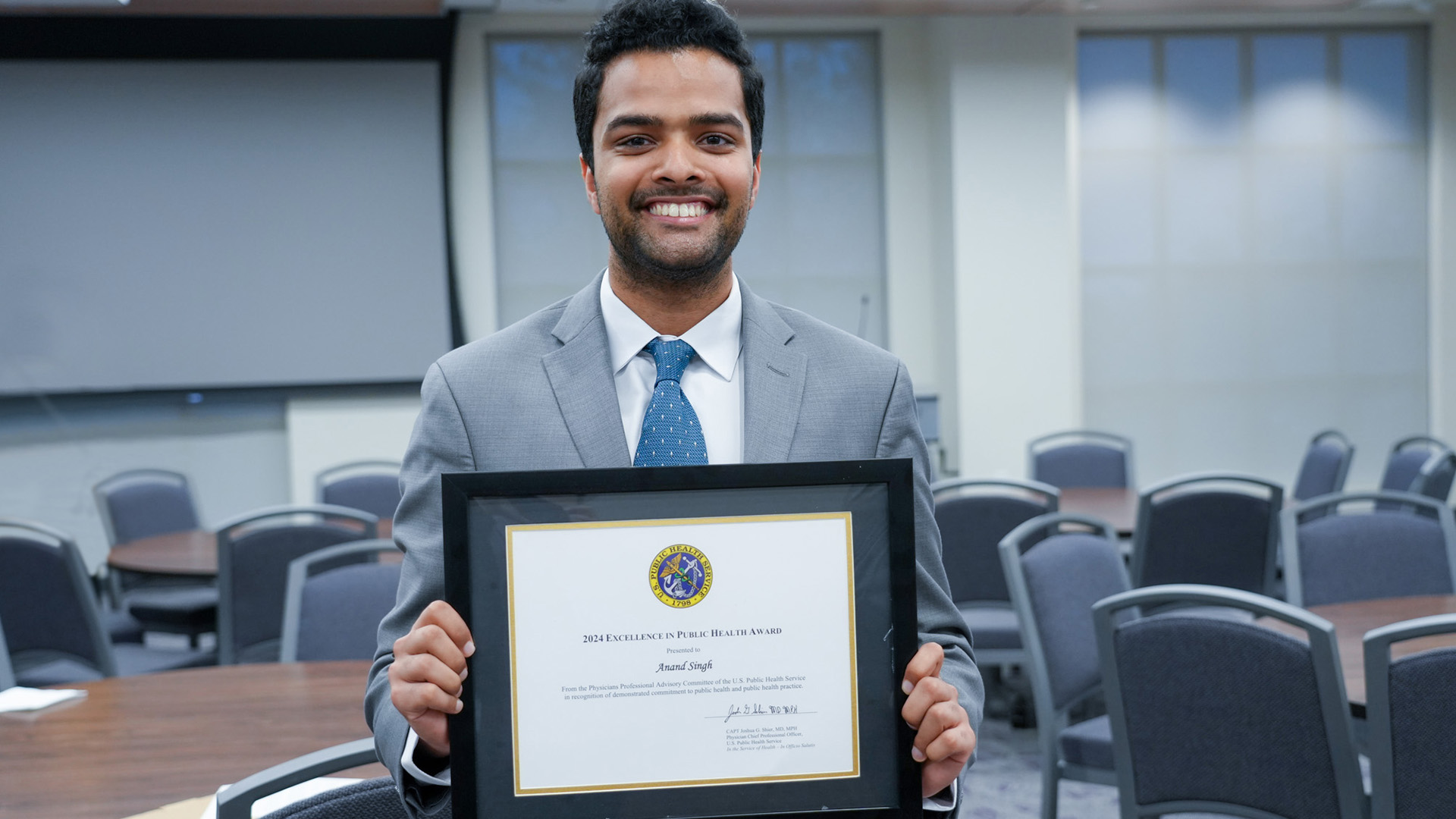
For his efforts, Singh was awarded the 2024 Excellence in Public Health Award from the Commissioned Corps of the U.S. Public Health Service Physician Professional Advisory Committee. The awards program recognizes medical students who have done exceptional work in their local community promoting public health and disease prevention.
“I’m extremely honored and really humbled to be selected for this award,” Singh said. “Throughout my medical school journey, I’ve really been involved with the community.”
Dr. Ikwo Oboho, M.D., ScM, Director of Infection prevention and control program at U.S. Veterans Affairs North Texas Health Care System, made the announcement via Zoom.
“Anand is very deserving of this award,” said Ric Bonnell, M.D.,Director of Service Learning at the Burnett School of Medicine at TCU. “The committee nominated Anand based on his impressive dedication to public health since entering medical school including projects for adolescent mental health, the homeless and socioeconomically disadvantaged cancer patients.”
Aside from his local community efforts, Singh is one of two medical students nationwide elected to the American Medical Association Foundation Board of Directors where he’s made it his mission to improve public health in the Dallas-Fort Worth area.
He was granted an Albert Schweitzer Fellowship, which led to a partnership with local schools to create a community program called Unity Healing Campsthat focuses on behavioral health of middle school kids in underserved communities.
Antonio Igbokidi, MS4, the 2023 Excellence in Public Health Award winner, presented this year’s award to Singh at TCU.
“Anand getting that award was special,” Igbokidi said. “He’s a dear friend of mine and I’m really excited for everything he has in store in his career. He’s going to make substantial change to the community and the medical field at large.”