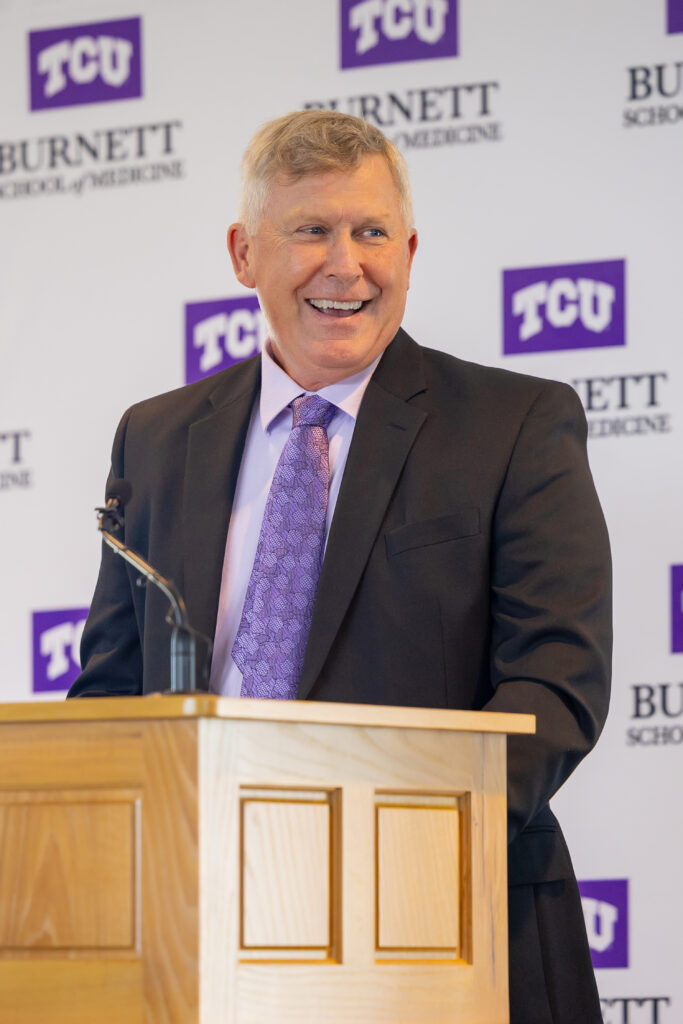
FORT WORTH – Melvin E. Clouse, M.D., passed away on July 25, 2024. He and his wife, Marian, established the Clouse Family Endowed Medical Scholarship, which has supported Burnett School students since 2022, and the Dr. Melvin E. Clouse Endowed Faculty Research Fund. To learn more about Dr. Clouse’s distinguished career, here is a link to his obituary.
Dr. Clouse met Dean Flynn in 2019 and was deeply inspired by the school’s vision and our approach to training Empathetic Scholars®. This encounter motivated his generous support of the Burnett School. Both funds are endowed, meaning the original gifts were invested for growth. Part of the interest earned is distributed annually to support student scholarships and research. Because the original balance is never touched, Dr. Clouse’s generosity creates an everlasting benefit for our students and faculty.
The Clouse Family has encouraged friends and colleagues to honor Dr. Clouse by contributing to the scholarship fund at TCU. Many have done so, ensuring that our students will receive even greater support in the coming years. The impact of Dr. Clouse’s legacy is profound. His contributions have not only provided immediate financial support but have also ensured a continuous source of funding that will empower future generations of Empathetic Scholars®.
“It’s horrifying to see what these chemicals and what these products and Nicotine can do to you,” Aysha Harris, a 7th grader from Young Women’s Leadership Academy said. “I thought the presentation was very well-informed and straight to the point.”
“To have someone from the Burnett School of Medicine at TCU on our campus is a great opportunity for our students,” said Rodney White, principal at Young Men’s Leadership Academy.
Vieira quickly got the students’ attention when he showed images depicting the impact of smoking and vaping on the human body. Pictures of blackened lungs, rotten teeth and toes that were black had students covering their eyes.
Some had their mouths wide open in disbelief at the damage that could be done.
“My point is to bring a medical aspect to it,” said Vieira. “There are so many other consequences of smoking, so I want to make sure that I get that across to students.”
In 2023, e-cigarettes were the most commonly used tobacco product among middle and high school students in the United States, according to the Centers for Disease Control (CDC). The data showed that over 500,000 students were in middle school and over 1,000,000 students were in high school.
White says he’s thankful that Burnett School of Medicine is reaching out to the youth about this important issue.
“I know they’ll be able to take this information home and spread the truth about these devices,” Principal White said.
Feedback from this presentation has been good, according to Korie Hawkins, Assistant Director of Service Learning and Community Engagement at Burnett School of Medicine.
Local schools have been reaching out to see if Vieira can spread the message to their students. It’s going to be impactful going forward, Hawkins added.
“This will allow students to understand the ramifications of their decisions,” Hawkins said. “We will have multiple opportunities to go out and empower the youth by encouraging them not to vape.”
Dr. Jeyarajah has been a professor and department chair at the Burnett School of Medicine at TCU since 2018. He is a renowned member of Methodist Richardson Medical Center attending staff, where he serves as Director of Gastrointestinal (GI) Surgical Services and Director of the Hepato-Pancreato-Biliary (HPB)/Advanced GI Fellowship Program.
“It is really quite an honor for me,” Dr. Jeyarajah said. “Representing a smaller and new medical school like us in this prestigious organization is really such a step forward for all of us.”
The 2024 ACS Academy of Master Surgeon Educators® Induction Ceremony will be held in Chicago, Illinois, on Friday, September 27th.
The ACS Academy of Master Surgeon Educators® is a unique program of the American College of Surgeons (ACS) that launched in 2017. Its first cohort of Founding Members and Associate Members were inducted in 2018. In 2019, a new category of Affiliate Membership was added.
Three categories of membership, which are Member, Associate Member and Affiliate Member, are open to master surgeon educators across all surgical specialties each year during an application process. Being selected for induction into the Academy demonstrates the highest achievements in the domain of surgical education and is evaluated by a stringent peer review process.
Each year the Academy sets out to identify innovators and thought leaders in surgical education who put innovative teaching ideas into action.
“We are one of the few medical schools in the country that has a longitudinal integrated curriculum which I love,” Dr. Jeyarajah said. “I feel that we’ve created such wonderful physicians because the proof is in the pudding we’ve managed to match our students so well, especially into surgical specialties.”
Dr. Jeyarajah trained at the University of Chicago and participated in a liver transplant fellowship at Baylor University Medical Center in Dallas. Afterward, he spent eight years in academic medicine at UT Southwestern Medical School. He’s received funding for his pancreatic disease research and authored more than 150 book chapters and articles in his career.
He serves as the Secretary of The Americas Hepato-Pancreato-Biliary Association (AHPBA) and chair of the Nominating Committee of the American College of Surgeons. He also serves as Chair of the Fellows Education Committee of the Society for Surgery of the Alimentary Tract.
Dr. Jeyarajah was also the accreditation chair, former President of the Fellowship Council and Governor of the American College of Surgeons. He served as the chair of the Program Director’s Committee of the AHPBA and was the former President of the North Texas Chapter of the ACS.
Dr. Jeyarajah hopes his acceptance into the Academy brings more notoriety to the Burnett School of Medicine’s forward-thinking approach to medical education.
“My job is to go out there and tell the world what a great job we’re doing over here,” Dr. Jeyarajah said. “To be recognized for this is really a recognition for the school not for me because they’ve allowed me to do this and do what I love.
It is an impressive visual design incorporating one of TCU’s most well-known landmarks on its main campus in Fort Worth’s Medical Innovation District (MID) and Near Southside, according to Stuart D. Flynn, M.D., Founding Dean of Burnett School of Medicine at TCU.
“I think that was the perfect image to have on this campus that reflects just beautifully and connects us with the TCU campus,” Dean Flynn said.
“We looked at whether it should be a painting but paintings can fade into brick over time and just lose that special feeling,” Ruesch said. “But to me, the mosaic really started to feel like it can be bold and stand the test of time but also just be that special touch.”
After a lengthy search, they hired Mosaicos Venecianos de Mexico (MVM) to design, fabricate, and install the mosaic art. Malena Perdomo Ventura, Director at MVM, selected Romeo De Candido, a mosaics installer from Italy, to perform the installation.
Next, they needed to choose an image to represent TCU in its first building to be built away from its main campus. TCU’s Chancellor Victor J. Boschini Jr., who has a tremendous passion for budlings on the TCU campus, wanted the medical education building to have a similar message, Dean Flynn added.
“We’ve all seen the fountain and to know what that feels like, what it sounds like when you’re on central campus,” Dean Flynn said. “The mosaic connects us to the university. It emulates that same kind of feeling here at the medical school.”
The mosaic art encompasses TCU Frog Fountain’s historical reference. Each flute of the fountain represents a different class at TCU and the knowledge flowing from the seniors down to freshman. Historically, the fountain’s lotus motif was chosen for its association with education. The mosaic art highlights the stylized flutes topped with lotus petals, as well as visually representing them with unique visual angles.
“Students can walk out the door and see that and feel like they’re instantly connected to TCU and the rich history and tradition,” Ruesch said.
From a distance the mosaic art looks as if it is one painting. But as you get closer the detail becomes more evident. The mosaic is made up of several hundred thousand tiny quarter inch by quarter inch glass tiles making the incredibly vivid image. It took MVM six months to lay the tiles at their studio in Mexico City, Mexico.
“They would send me progress photos every month and it was it was really amazing to watch,” Ruesch said.
The mosaic’s deeply saturated color and tones are crisp, but not so bold that they take away from the serenity of the archway arcade space. The mosaic art complements and is cohesive with the architecture and materials of the archway. The design team felt like a rich pop of color would be very important, Ruesch added.
“We figured that people would be eating their lunch out there or leaving the office or school every day,” Ruesch said. “There’s a lot of neutral tones on the exterior of the building so we really wanted something that would pop and catch your eye as you’re leaving or as you’re driving by on Rosedale.”
Romeo De Candido came to Fort Worth for the on-site installation process where crews had to reassemble the tiny glass tiles of the mosaic art inside the archway. It stands approximately 20 feet by 6 inches tall and 19 feet by 10 inches wide. It took 10 days for the crew to reassemble it.
The mosaic art serves to be an inspiration for collaboration and community.
“I think this is going to carry through the decades and how our visitors and our students feel about this environment,” Dean Flynn said. “I’ve never been in such an inviting medical school building before and I love this.”
FORT WORTH – Discipline and grit are qualities that competitive athletes need to master at a young age to eventually compete on the world’s biggest sports stages.
“Sometimes I look at all the things I got to do and I’m like I can’t even fathom how I’m going to start to do it,” Choy said.
Choy was a member of Team USA at this year’s FISU World University Championships where teams from 22 countries competed for gold, silver and bronze medals. The FISU World University Championships are not considered an Olympic sport but are considered the highest level of competitive collegiate power weightlifting.
“When kids start playing football they envision themselves in the Super Bowl,” Choy said. “When I was powerlifting as a 14-year-old I envisioned myself at the World Championships.”
He grew up in Wisconsin and began power weightlifting in 2014 while in high school. By the time he graduated he was one of the top-ranked power weightlifters in the U.S. within his weight class of (-74kg/163.14 lbs.). He went to Northeastern University in Boston, Massachusetts, continuing his dream of one day competing in the FISU World Championships but the competition got tougher.
“In college, the guys got a lot stronger and I didn’t,” Choy said.
Choy trains five days a week for three to four hours a day alongside his coach. He does high-repetition squats three times a week, bench presses four times a week and deadlifts twice a week. These workouts include accessory work to make sure he’s building more muscle every step of the way.
“Even within that work it’s not like just hit this number there are velocity targets I have to hit,” Choy said. “There’s subjective rating systems I use to figure out how much of a load I need to be lifting. Take care of any aches and pains and then you go home and do it again the next day.”
Choy managed all this while balancing his first three years of medical school spending a lot of class time inside Fort Worth area hospitals through the medical school’s rigorous Longitudinal Integrated Clerkship (LIC) curriculum.
“The Burnett School of Medicine at TCU does a very good job of making sure we have a mix of time spent together but also enough white space to kind of pursue our own learning,” Choy said. “I was able to leverage and have enough time to train.”
With medical school and training going well, he seemed to be on his way to having a strong showing at the Power Lifting America University Nationals to qualify for Team USA in March 2024.
But in December 2023 adversity struck in the form of perforated appendicitis.
“It was my intention to go to those and cap off my collegiate powerlifting career then the appendicitis happened and it kind of threw me for a loop,” Choy said.
At the time he was studying appendicitis in his course work when he started to feel daily pains in his abdomen.
“I remember thinking there’s just no way it’s all in your head,” Choy said. “The pain just got worse and worse and eventually I was bent over every day groaning and feverish. Then my appendix exploded which is one of these true surgical emergencies.”
He was hospitalized for a week. Determined to see his dream come true he began rehabbing in his hospital room after his surgery. He resumed training from ground zero lifting an empty barbell and doing push-ups. He worked with his coach to create a weightlifting protocol that wouldn’t aggravate his surgery scars and healing process.
“I took it one day at a time,” Choy said.
He had 12 weeks to get in shape to participate in nationals to qualify for Team USA. He needed to win a gold, silver or bronze medal at the event to qualify. In March 2024, he won a silver medal making him a member of Team USA. At the FISU World University Championships in Estonia he helped Team USA come in 4th overall.
He finished 15th in his weight class (-83kg/182.98 lbs.) by lifting (617kg/1,360.25 lbs.) of total weight.
“It’s such a moment of pride and pause that I competed at the highest level in the sport,” Choy said.
Now he plans on putting even more of his focus, discipline and grit into completing medical school.
“I can see myself being an orthopedic surgeon,” Choy said. “Being an athlete it’s given me this nice hands-on personal appreciation of the muscular-skeletal system and all the diseases it kind of falls with.”
“I think it’s easy to always fall into this trap of always needing to study and do well,” Dennis said. “Learning some simple techniques and basic meditation can be a helpful way to take a break and reduce stress.”
“These bodies, our minds and hearts, these are the things we carry with us,” Keaton said. “This allows us to do what we do and if we’re not taking care of those things we can’t do what we are called to do.”
Another part of setting students up for success is making sure they are aware of the resources available to them.
“We want to start from day one inspiring that lifelong learner,” Dr. Nelson said. “They’re not going to know the answer to everything but we’re going to teach you how to find the answers and how to rely on your classmates and faculty and staff.”
The Class of 2028 heard from a panel of five upperclassmen and received some great insight about their journey and how they have navigated medical school so far.
“We have valuable resources that we can reach out to,” Ismaio said. “Knowing that makes you feel like a greater sense of community and closer ties to the people and the community you want to serve.”
Throughout the two-week course, the students met faculty and staff, had dinner with Burnett School of Medicine Department Chairs, learned about school policies, curriculum and toured the Simulation & Technology classrooms.
Sylvia Inkindi, MS-1 at Burnett School of Medicine, who was selected by her classmates as the student speaker at the White Coat Celebration loved everything about Introduction to Medicine.
“Introduction to Medicine really got me excited about the curriculum at Burnett School of Medicine at TCU,” Inkindi said. “I really got a feel that this is a family environment and it’s going to be my home.”
FORT WORTH – A group of 40 junior high and high school students gathered in a corner of a classroom inside TCU’s Sid W. Richardson Physical Sciences Building putting on scrubs and gloves for a lesson on dissection using cow eyeballs.
They broke off into smaller groups at long black high-top tables and watched as Haya Qadurra, a Senior and Pre-medical major at TCU, took a small scalpel and made incision marks around an eyeball.
“Oh my goodness,” Alivia Offord, an 11th grader at V.R. Eaton High School said.
Offord’s eyes opened wide as Qadurra handed her the scalpel.
“You’re going to cut this all the way down,” Qadurra said.
A classmate, Jarvis Lard, an 11th grader at Steele Early College High School, leaned over Offord’s shoulder with a grimaced look on his face as she chiseled the eyeball in half.
“Oh my god it looks like slime and look it’s blue,” Offord said. “I’m so glad I have on gloves.”
Qadurra picked up the eye lens and explained its functions and how it connects to the body. Most middle and high school students don’t get this level of exposure to medicine, according to Ric Bonnell, M.D., Assistant Professor at Anne Burnett Marion School of Medicine at Texas Christian University.
“There’s nothing like that hands-on holding that eyeball taking the lens out and looking at it,” Dr. Bonnell said. “I expect kids to not just enjoy this but remember it for a long period of time and hopefully it inspires a lot of them to go into health care.”
In early June, the Burnett School of Medicine at TCU held a weeklong Mini Med School summer program for middle and high school students in Fort Worth. The program was run through the medical school’s Service Learning & Community Engagement curriculum from a grant they received. The goal is to spark an interest in medicine in young kids and teach them more about careers in health care they may not be aware of.
“We’re having them be mentored by our medical students and pre-med students at TCU and we also want them to have a lot of fun,” Dr. Bonnell said.
For five days the students participated in an Introduction to Medicine, Slice of Science: Dissection & Narcan Awareness, Community Health and Awareness, Simulation Lab, and Case Study courses. The curriculum aimed to dispel the Hollywood version of how doctors and nurses work to solve complex cases.
“On the first day we treated them like we treat our medical students or my medical residents at the hospital,” Dr. Bonnell said. “We gave them real patient cases in groups and had them be detectives and try to figure it out.”
The Student Becomes The Teacher
Midway through the week students met Ethan Vieira, MS4 at Burnett School of Medicine, for the Community Health and Awareness course. It involved more discussion among him and the students than the hands-on exercises earlier in the week.
“What do you all know about vaping are people doing it,” Vieira said.
The room full of high schoolers answered, yes, in unison. He followed that up with another question.
“Are they doing it at school and how do they do it at school,” Vieira said. Again, in unison, they responded with a very specific answer.
“In the bathroom,” the students said.
Two months earlier Vieira designed this presentation for middle and high school students with Dr. Bonnell’s help. The presentation called, “The Effects of Smoking, Vaping and Tobacco Use,” came out of his own experience as a sixth grader.
“The D.A.R.E. curriculum and the impact that had on me is why I chose to this point to never smoke or try recreational drugs,” Vieira said. “I just I remember this hairy tongue that they showed us that has stuck with me forever.”
Vieira shared tidbits of his own personal experiences dealing with peer pressure to smoke and clinical experiences with patients who are smokers. He’s only a few years removed from undergraduate education and high school, so he understands how inundated young people are with images of smoking.
“People on social media are making rings with smoke and doing tricks showing a side of smoking that they try to make look cool,” Vieira said. “Part of my job and giving this talk and something I try to show is that’s like 0.02% of it. The reality of smoking are the risks to your health and the risks to the health of those around you.”
This is how the Burnett School of Medicine inspires medical students to not only be life-long learners but also life-long teachers, according to Dr. Bonnell.
“Our medical students are teaching high school, undergrad, and junior high students and they’re starting to learn and model that behavior,” Dr. Bonnell said. “They’re going to need to do this well for the rest of their life and careers. It’s a win-win for both sides.”
Leaving A Lasting Impact
On the final day students were partnered with a medical student or pre-medical student mentor for a high-paced activity called, “Stop The Bleed.”
Dr. Bonnell cued up Leona Lewis’s hit song “Bleeding Love” on a Bluetooth speaker and began timing the students as they stuffed gauze bandage into a piece of foam with an open hole.
Aleyah Akuma, 11th grader at Trimble Technical High School, quickly stuffed the gauze bandage into the hole as Dr. Bonnell watched counting. Once she filled the hole, she stood up, crossed her hands together, put them over the hole and applied pressure.
“Make sure you keep pressure on it through your entire arm,” Dr. Bonnell said.
He counted to ten and then told her to relax.
“Congratulations you did it you stopped the bleed,” Dr. Bonnell said.
“I want to go into medicine so I’ll be here again next summer,” Akuma said.
The exposure to medicine doesn’t stop with the weeklong program. The students will meet up with the Service Learning team again in August before returning to school for the Fall.
This program is all about piquing their interest in becoming a doctor or the other allied health professions and growing their knowledge base, Dr. Bonnell added.
“We want to expose them to as many different areas of medicine we can,” Dr. Bonnell said.
FORT WORTH – If you take a ride down Camp Bowie Boulevard that runs through the COMO neighborhood in Fort Worth you might see residents pushing carts along the sidewalk filled with food.
They’ve likely taken a mile-long trek to a food bank in search of healthier food options.
“That really breaks my heart,” Sandra Stanley, Ph.D., CEO & Founder of Opening Doors For Women In Need said. “They are just trying to make it just trying to survive.”
There are an estimated 280,000 Fort Worth residents living in a food desert, which is defined by being situated a mile or more from a full-service grocery store, according to the Tarrant County Food Desert Project. To get affordable and healthier foods, residents without transportation in COMO must find a way to travel at least a mile outside of their neighborhood.
COMO is located in 76107 area code of East Fort Worth and has 31,591 residents, according to the U.S. Census Bureau. The neighborhood is a little more than one-mile long in all four directions but only has three grocery stores (Tom Thumb, Natural Grocers, and Central Market) that carry fresh produce.
A lot of residents will venture outside of the neighborhood to find more affordable grocery stores, Stanley added.
“A lot of our community goes to Walmart marketplace because it’s more affordable for them,” Stanley said. “The local little stores we call them the corner stores they don’t have vegetables.”
Stanley is a longtime COMO resident who also runs the COMO Community Garden at the corner of Humbert Avenue and Prevost Street. She is trying to reduce the need of residents traveling outside the community for fresh food by offering what is in her garden for free.
“We harvest a lot and take it to the senior center or anyone can have it the gates are always open,” Stanley said.
Keeping the gates open is simple. However, keeping the garden fertile and growing crops has been a challenge. After the COVID-19 Pandemic made social distancing more common, the number of volunteers at the community garden dropped off, Stanley added.
“We’re just trying to keep our doors open and survive,” Stanley said.
“We hit it off really good and I started talking to him about our non-profit (Opening Doors For Women In Need) and that’s when he said let’s work together,” Stanley said.
The interconnectedness of food and health is something that resonated heavily with Whitaker Reid, MS-2 at Burnett School of Medicine. He lives in COMO and previously had a positive experience at a different community garden prior to starting medical school.
“I saw the impact that had especially for individuals who are food insecure,” Reid said. “When I saw the opportunity to do a social impact challenge here at TCU I thought we have something right here in our backyard and it’s just waiting to be given extra time, love and attention.”
Before putting hands in the dirt and boots on the ground, Whitaker felt it was important to meet Stanley and listen.
“He was very, very sensitive and asked me what I wanted to see and what I needed help with and listened to what I needed,” Stanley said.
“Learning to communicate with patients and understanding their story is a huge part of medicine that gets overlooked,” Dr. Bonnell said. “Doing service learning projects gives them the opportunity to meet their patients outside of the hospital setting and understand them as people. That way when they see them in the hospital they have a better perspective on how to provide care.”
BOOTS ON THE GROUND
In the spring, Reid and a group of medical students began helping Stanley revitalize the community garden to prepare for a summer harvest. Students planted tomatoes, peppers, squash, onions, greens and a few marigolds around to help keep the bugs away.
“We know how busy that they are studying for them to take time and come and help us it makes my heart warm,” Stanley said.
Through the Service Learning & Community Engagement curriculum Reid was able to apply to the medical school’s Social Impact Program and receive a grant from the Brumley Fund to purchase new gardening tools, pots and soil for the garden.
“That’s all for this community to benefit from,” Reid said.
He plans to help Stanley create an irrigation system and, hopefully, a little greenhouse to have year-round plantingat the garden.
“But right now it’s just getting the garden prepped and showing commitment to being involved in this community,” Reid said.
“I am proud that I can help and give back in this way,” said Chef Hao Tran, Instructor of the Culinary Arts at Trimble Tech High School. “If we can provide residents with nutritional guidance and help them to be healthy this will benefit the community.”
Here’s how the partnership will work. Burnett School of Medicine at TCU students will teach the high school students about certain health conditions such as diabetes, hypertension, or heart failure. They will then work together to create affordable meal plans for patients in the community who deal with those conditions.
“We know that healthy eating along with exercise is more important to long-term health than just about anything,” said Ric Bonnell, M.D.
Trimble Tech High School is literally across the street from Burnett School of Medicine at TCU’s new medical education building named Arnold Hall.
Bonnell is excited about the partnership, which is possible thanks to the Rebecca Brumley Service Learning Endowment Fund.
The program will be beneficial to the medical students, Dr. Bonnell says, and will help them “understand that health is more than prescribing medicine or seeing patients at a hospital, but it’s also about interacting with community members and what makes them healthier.”
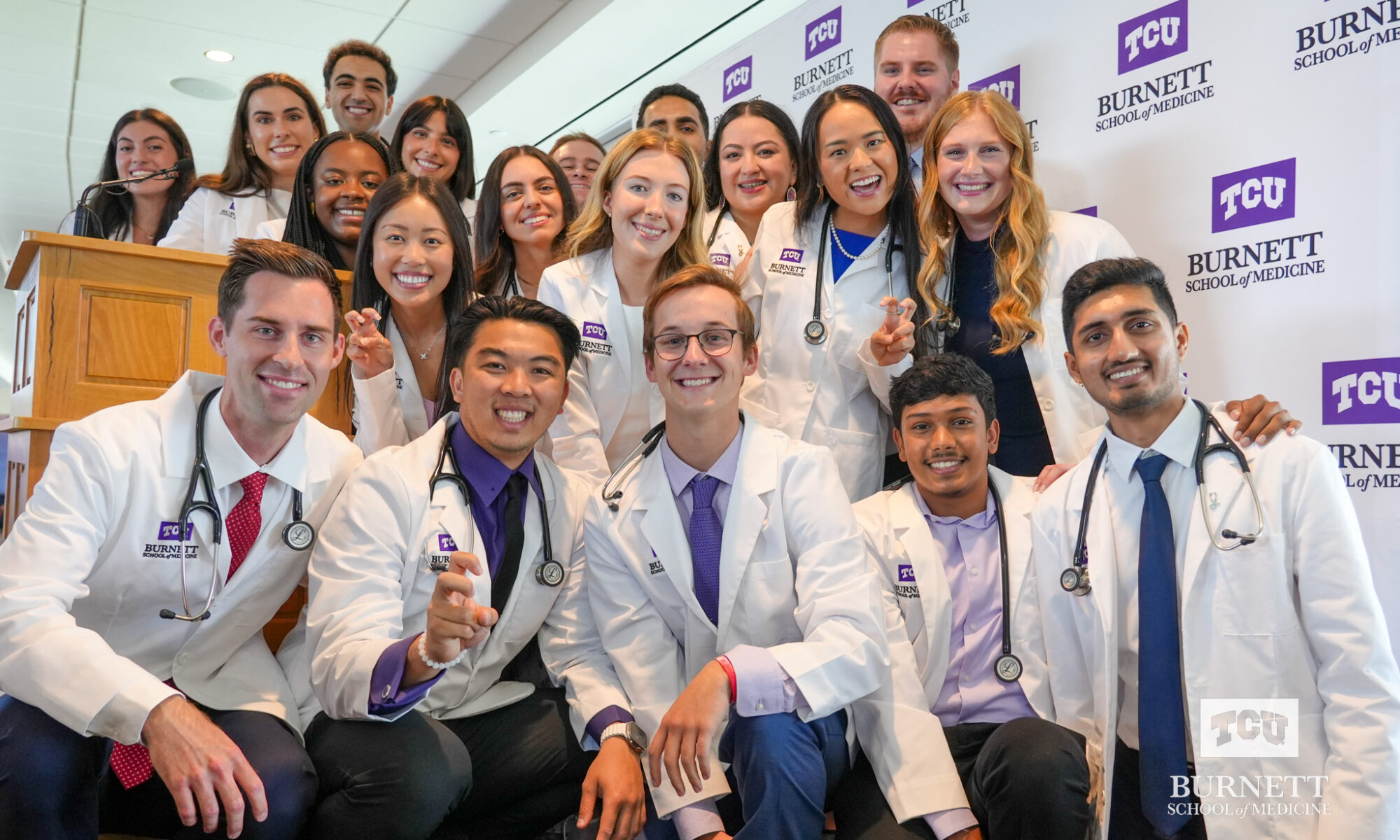
“We are thrilled to welcome our sixth group of Empathetic Scholars® and future physicians,” said Stuart D. Flynn, M.D., the Founding Dean of the Burnett School of Medicine at TCU. “This group will begin their medical education journey in our brand new medical education building in the heart of Fort Worth’s Medical Innovation District (MID) just steps away from all our clinical partners. This group has a distinctive opportunity to learn to practice medicine with empathy and amass deep medical knowledge from physicians and patients in our community.”
More than 6,590 applied to be one of 60 medical students selected for the class of 2028. The first-year medical students represent 18 states with more than a quarter from Texas. There are also eight students that graduated from TCU. Fifty-seven percent of the class self-identifies with one or more of the three school-defined diversity domains: race/ethnicity, LGBTQ, or socio-economic limitation.
Founding Dean Stuart D. Flynn, M.D.
First-year medical student Sylvie Inkindi was selected by her peers to represent the class of 2028 at the White Coat Celebration. Inkindi worked as a Public Health Microbiologist with the Los Angeles County Public Health Lab before coming to medical school.
“We may have taken different paths but we all find ourselves here today finally donning our white coats.,” Inkindi said. “This moment represents the culmination of years of hard work but it also marks the beginning of a lifelong commitment to the noble profession of medicine.”
Every year, white coat ceremonies are held by medical schools across the United States. New medical students receive their short white coats signifying the beginning of their journey to achieve the long white coat, when they are physicians, according to the American Medical Association.
Burnett School of Medicine at TCU students received their white coats at TCU’s Legends Club at Amon G. Carter Stadium in front of faculty, staff, family, and friends. The medical school puts its own twist on the traditional celebration by having family members gather around each medical student to help them put on their white coat for the first time.
Floyd Wormley Jr., Ph.D., Interim Provost, Vice Provost for Research, and Vice Chancellor for Academic Affairs at TCU, served as a guest speaker at the celebration. Friends and family will be essential in supporting students through the arduous journey of medical school, he added.
“You will encounter many challenges on your journey and you have the opportunity to discover solutions to vexing problems,” Dr. Wormley said. “Don’t be afraid to battle the unknown to look for better treatments and cures. You can be the one who takes on these challenges whether in the lab or in the clinic. A doctor’s task is all about discovery. At TCU, we emphasize that by encouraging students to innovate and become life-long learners.”
The Burnett School of Medicine graduated its second class of medical students in May. The school’s novel Empathetic Scholar® curriculum prepares students to be compassionate physicians with a breadth of medical knowledge to tackle rapid advances in medicine.
“The way we’ve designed this forward-thinking curriculum puts our medical students at the forefront of medical innovation,” Dean Flynn said. “They will be equipped with unique skills to deliver patient care now and into the future while having the ability to adapt to new medical advances as they arise.”