Fort Worth – The Anne Burnett Marion School of Medicine at Texas Christian University and The University of Texas at Arlington (UTA) announce the launch of a pioneering joint M.D.-Ph.D. program in biomedical engineering.
This innovative program will cultivate a new generation of physician-scientists who can bridge the gap between cutting-edge biomedical research and clinical practice. The first cohort of candidates will be considered during the 2024 M.D. admissions cycle and begin their studies in July 2025.
The dual-degree program merges the Burnett School of Medicine at TCU’s novel approach to medical education with the interdisciplinary research expertise of UTA’s Department of Bioengineering. The Burnett School of Medicine has successfully graduated its first two classes of physicians who have matched into some of the top residency programs in the U.S., like The Mayo Clinic, Stanford Health Care, UCLA and The University of Michigan.
“This collaboration will give students career advancing in-depth knowledge and skills in medicine and biomedical engineering to lead advancements in health care innovation,” said Stuart D. Flynn, M.D., Founding Dean of the Burnett School of Medicine. “Combining the expertise of both of these programs will provide an amazing opportunity for students to accelerate their knowledge and advance health care and research.”
The Ph.D. portion of the program, run by UTA, is designed to provide students with a robust training in biomedical engineering. Students will engage in rigorous coursework with significant laboratory-based research in a faculty investigator’s laboratory culminating in a doctoral thesis.
“This collaboration is a unique opportunity for UTA to leverage our half-century of providing education and research in biomedical engineering in North Texas,” said Peter Crouch, Ph.D., dean of UTA College of Engineering. “We are confident that working side-by-side with TCU’s medical students in performing specialized research, we will give them the knowledge they need to be pioneers in blending traditional medicine and technology.”
The United States faces a significant shortage of physician-scientists, individuals who are critical for driving biomedical advances and improving health care nationally and globally. This joint M.D.-Ph.D. program will prepare students to address some of the most vexing biomedical challenges of our time. Graduates of this program will be leaders in advancing discoveries in health care in the 21st Century.
Students enrolled in this program will have access to:
A curriculum that integrates the latest in medical education with cutting-edge biomedical engineering research.
Opportunities to be a member of cutting-edge research projects.
Guidance from leading faculty members who are at the forefront of their respective disciplines including bioinstrumentation, biomaterials and tissue engineering, biomechanics, medical imaging, and nanomedicine/nanotechnology, among others.
Graduates will be exceptionally prepared for careers in academic medicine, biomedical research, biotechnology, and regulatory agencies.
This joint M.D.-Ph.D. program represents a significant step forward in addressing the critical need for physician-scientists and offers students an opportunity to be leaders in health care innovation and advances.
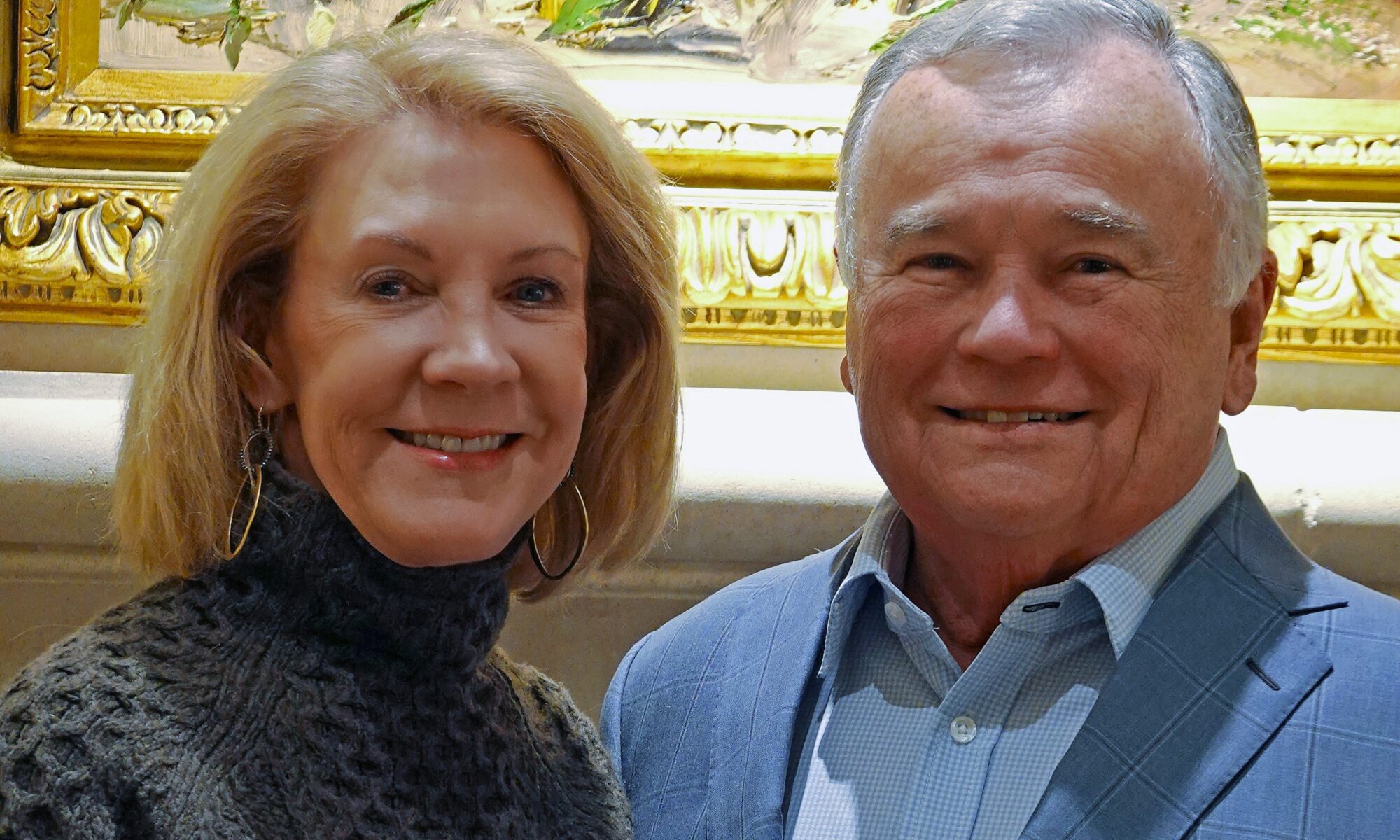
FORT WORTH – The Burnett School of Medicine at TCU exceeded its goal on TCU Gives Day 2023 and secured a $50,000 Challenge Grant for scholarship support from Janeen and Bill Lamkin.
Servant Leadership is a Core Value of the Anne Burnett Marion School of Medicine. The Lamkins have served in volunteer leadership roles at numerous Fort Worth organizations and institutions for four decades, showing no signs of slowing down.
Texas Christian University and the Burnett School of Medicine at TCU are grateful beneficiaries of their generosity. Janeen has served as a community representative on the Admissions Committee of the School, pouring through hundreds of applications and reviewing the unique qualifications of applicants. Together, Janeen and Bill endowed a scholarship in 2019 as the Burnett School accepted its first students, setting an early example that many others have followed. Their generous annual gifts continue to support the School and its mission.
“We live in one of the fastest growing communities in the United States and in addition, it’s an aging community. Both of those factors demand that we increase the number of healthcare providers in order to meet the increased needs.” Bill continues, “By having the Burnett School of Medicine in Fort Worth it encourages new doctors to start their careers in the local area, which will greatly help support our communities’ needs both today and in the future.”
Highlighting Bill’s community service has been 19 years of involvement with Texas Health Resources including the Texas Health Resources Foundation Board (two years as Board Chair), the Texas Health Harris Methodist Finance Committee (Chair), Texas Health Community Impact Board and, currently, the Texas Health Resources Finance Committee.
Janeen, a 1989 TCU Neeley School of Business graduate, has also focused on health and the welfare of those most vulnerable in her volunteer roles. ACH Child & Family Services, Ronald McDonald House, and Texas Health’s Kupferle Health Board have all benefited from her investments of time and treasure.
“Having the honor of serving on the Burnett School Admissions Committee alerted me to the fact that students take on an average medical school debt of over $200,000. Anything we can do to minimize this added stress for our medical students, as well as the financial burden for our future caregivers, is a worthwhile investment.”
Janeen and Bill Lamkin are once again stepping up as Burnett School Challenge Donors for the 2024 TCU Gives Day effort.
They have pledged an additional $50,000 scholarship gift, which will be unlocked when 150 or more donors contribute this year. Your donation, no matter the size, will honor the Lamkins’ commitment and enhance the Burnett School’s ability to recruit and retain the most talented students, regardless of their financial circumstances.
3,066 donors provided more than $1.86 million in gifts across TCU for TCU Gives Day, making this a successful year for donor participation in the event’s 11-year history.
FORT WORTH – Teaching medical students to put the patient at the center of care and create a partnership between physicians, patients, and their families is a unique approach to medical education.
Stuart D. Flynn, M.D., the Founding Dean of the Anne Burnett Marion School of Medicine at Texas Christian University, and Jacque Chadwick, M.D., Special Assistant to the Dean, are trailblazers on this type of medical training. They are using that patient-centered model to create Empathetic Scholars®and physicians of the future.
“The delivery of health care is broken,” Dr. Chadwick said. “It’s not doing the best it can do for the patient, and so we need to have these doctors prepared to function within the system that exists.”
In a traditional four-year medical school curriculum, the preclinical phase is two years of science training where students sit in lectures learning about basic medical concepts, structures, functions of the body, diseases, diagnoses, and treatment concepts, according to the Association of American Medical Colleges (AAMC). The last two years are when students begin clinical rotations and get hands-on experience with patients in the major medical specialties.
The Burnett School of Medicine at TCU has flipped that model and pairs students with physicians and their patients in the major medical specialties all four years of their curriculum.
“I think every medical school obviously thinks about caring for patients, but then you have to see it ingrained in the culture of your environment – that’s how we put this school together,” said Dean Flynn.
Dean Flynn and Dr. Chadwick, discussed the creation of the medical school’s unique Empathetic Scholar®curriculum with faculty, staff and students during a panel discussion at the medical school moderated by Judy Bernas, Senior Associate Dean and Chief Communication and Strategy Officer.
“The faculty physicians here are paying back what they got when they were medical students and that is training the next generation of doctors with empathy and compassion,” Dean Flynn said.
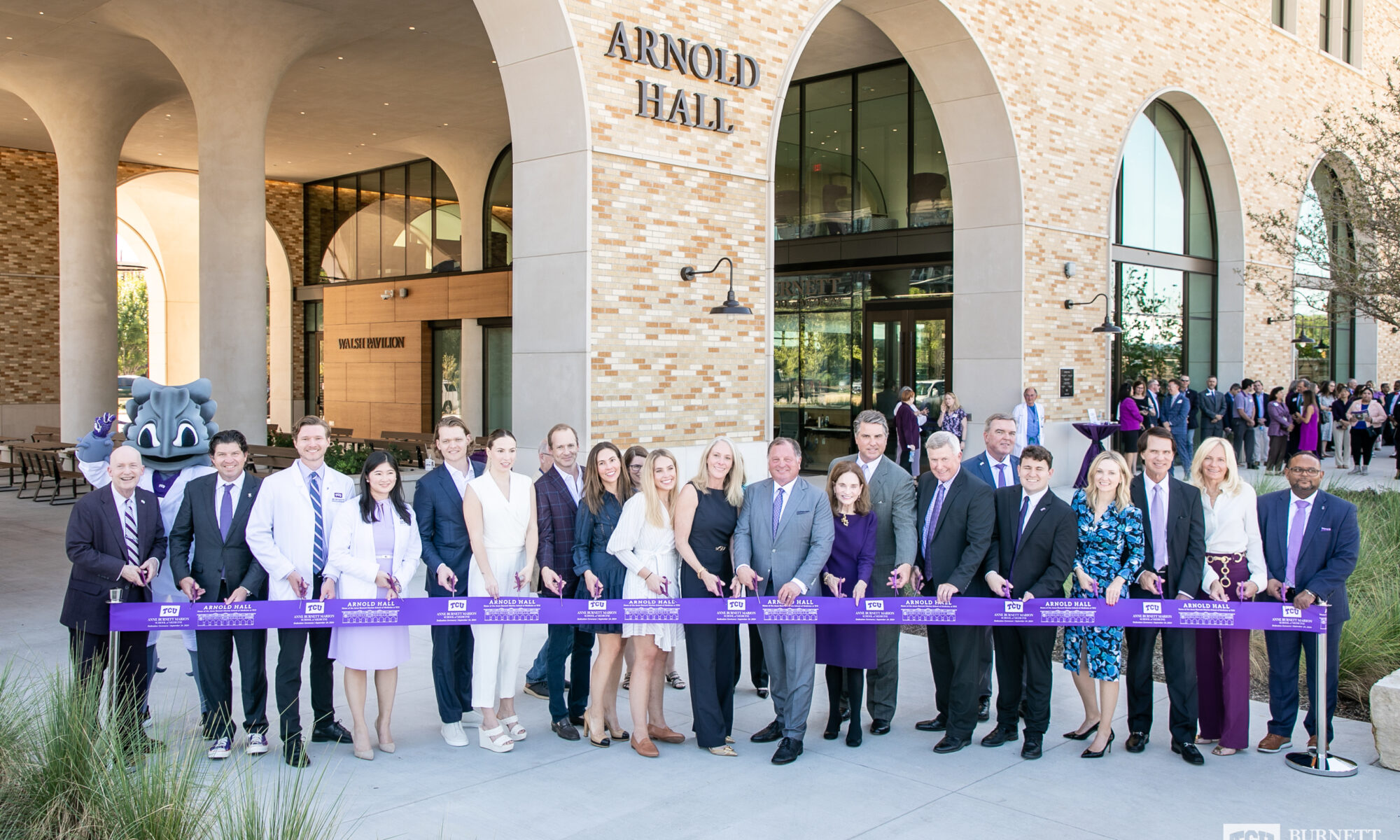
The conversation followed the Burnett School of Medicine at TCU’s Dedication Event for its new medical education building, named Arnold Hall, in Fort Worth’s Medical Innovation District.
The impetus in creating an Empathetic Scholars® model began in the late 2000s when both Dr. Flynn and Dr. Chadwick worked for the University of Arizona College of Medicine – Phoenix.
Dr. Flynn served as the College of Medicine’s Founding Dean and Dr. Chadwick served as Vice Dean. They implemented a few concepts, however, they had to contend with the established curriculum, which had been in place since the early 1990s.
“We were given a curriculum, especially the clinical curriculum, from an established school that was very traditional. We were not able to change that at all,” Dr. Chadwick said. “We were able to create first- and second-year curriculum that was brand new and very different that we were proud of, and I think that gave us a bit of an appetite to do something full scope that we could create new.”
Dean Flynn’s expertise was in medical school curriculum and Dr. Chadwick excelled at clinical education. To do something radically different in medical education, they would need an opportunity to create a new medical school from the ground up so they could shape the culture and DNA of the school.
“If you start a new medical school, I think you’re obligated to take advantage of it,” Dean Flynn said. “At least where you can predict where medicine might be 5 or 10 years from now. It’s kind of hard to predict much past that.”
Dean Flynn, Dr. Chadwick, and a small team arrived in Fort Worth in 2015. They began laying the groundwork of what would become the Burnett School of Medicine and its Empathetic Scholar® curriculum. In those days, they would sit with about 30 to 40 physicians and basic scientists in a large room posing questions to one another.
What kind of medical student would you be proud of as a graduate of this medical school? What kind of physician would you want after residency? What kind of physician would you want for you and your family?
“Initially, the conversation with some of the groups was that we need the traditional, sit-in-a-lecture-hall curriculum,” Dr. Chadwick said. “It was very hard to convince some physicians that it might be better to do things different.”
Once the idea of creating a new paradigm of medical education came to fruition, the process became fun, Dean Flynn said. They set out to create a curriculum that’s forward-thinking and trains medical students for where medicine is going.
“Knowledge and technology is escalating big time,” said Chadwick recalling the early discussions on the new curriculum. “We focused on lifelong learning and critical thinking. How do you get the students to not memorize, but to interact with the material, the technology early on?”
The curriculum was also built to be adaptable and flexible as the medical school evolves, Dean Flynn said.
Another important part of the curriculum is to prepare future physicians for today’s health care industry.
When Dr. Flynn and Dr. Chadwick were in medical school, they never learned about the health care system. Medical students today “need to know about those things and hopefully be leaders to change it back to being a patient-centered way of delivering care.” Dr. Chadwick said.
The inaugural class of medical students, known as the Dorman Scholars, began in July 2019. Since then, the medical school has matriculated a full student body of 240 students, which is 60 students in each class, and graduated two classes. Graduates of the medical school have landed residency spots in top programs such as, The Mayo Clinic, Stanford Health Care, UCLA Health, Vanderbilt, University of Michigan, New York University, and University of Texas Southwestern Medical Center.
“I’m turning around to hand the baton to the next generation, and I want them to not only be able to take care of me and my family and all of their patients in the best way possible,” Dr. Chadwick said. “I want them to be the next group of leaders who want to also do their very best. I want them to be changeable and teachable.”
Servant Leadership is a Core Value of the Anne Burnett Marion School of Medicine. If looking for a couple that embodies this value and has proven so time and time again, look no further than Janeen and Bill Lamkin. The Lamkins have served in volunteer leadership roles at numerous Fort Worth organizations and institutions for four decades, showing no signs of slowing down.
Texas Christian University and the Burnett School of Medicine at TCU are grateful beneficiaries of their generosity. Janeen has served as a community representative on the Admissions Committee of the School, pouring through hundreds of applications and reviewing the unique qualifications of applicants. Together, Janeen and Bill endowed a scholarship in 2019 as the Burnett School accepted its first students, setting an early example that many others have followed. Their generous annual gifts continue to support the School and its mission.
“We live in one of the fastest growing communities in the United States and in addition, it’s an aging community. Both of those factors demand that we increase the number of healthcare providers in order to meet the increased needs.” Bill continues, “By having the Burnett School of Medicine in Fort Worth it encourages new doctors to start their careers in the local area, which will greatly help support our communities’ needs both today and in the future.”
Highlighting Bill’s community service has been 19 years of involvement with Texas Health Resources including the Texas Health Resources Foundation Board (two years as Board Chair), the Texas Health Harris Methodist Finance Committee (Chair), Texas Health Community Impact Board and, currently, the Texas Health Resources Finance Committee.
Janeen, a 1989 TCU Neeley School of Business graduate, has also focused on health and the welfare of those most vulnerable in her volunteer roles. ACH Child & Family Services, Ronald McDonald House, and Texas Health’s Kupferle Health Board have all benefited from her investments of time and treasure.
“Having the honor of serving on the Burnett School Admissions Committee alerted me to the fact that students take on an average medical school debt of over $200,000. Anything we can do to minimize this added stress for our medical students, as well as the financial burden for our future caregivers, is a worthwhile investment.”
Janeen and Bill Lamkin are once again stepping up as Burnett School Challenge Donors for the 2024 TCU Gives Day effort.
They have pledged an additional $50,000 scholarship gift, which will be unlocked when 150 or more donors contribute this year. Your donation, no matter the size, will honor the Lamkins’ commitment and enhance the Burnett School’s ability to recruit and retain the most talented students, regardless of their financial circumstances.
Join the Lamkins and the Burnett School of Medicine in supporting our Empathetic Scholars® who, as TCU physician graduates, will lead on the transformation of health care.
FORT WORTH— The Anne Burnett Marion School of Medicine at Texas Christian University celebrates the dedication of its new 95,000-square-foot medical education building in the heart of Fort Worth’s Medical Innovation District (MID) with a celebration on Tuesday, Sept. 24.
This innovative medical education building features cutting-edge technology and education spaces to train the next generation of physicians. Completed in June 2024, the building welcomed the sixth class of medical students in July and is home to more than 240 medical students, as well as hundreds of faculty and staff.
“This beautiful and functional new medical education building now known as Arnold Hall shows TCU’s continued investment in Fort Worth,” Victor J. Boschini, Jr., TCU Chancellor, said. “Here, we inspire students to be leaders in their field, give back to their communities and provide the most compassionate care. All of us at TCU express our deepest appreciation to Ashley and Greg Arnold for their significant and continued support and for helping our vision become a reality.”
The building was named Arnold Hall in honor of Ashley and Greg Arnold of Dallas, Texas, for their generous philanthropic support of TCU and the Burnett School of Medicine. The Arnolds are longtime supporters of the university and have been involved as parents of three TCU graduates, and Greg serves the university as a member of the TCU Board of Trustees. They have made major gifts to TCU and the Burnett School of Medicine over the years. In 2023, they created the Ashley and Greg Arnold Endowment to provide perpetual support for annual operations of the Burnett School of Medicine and they supported Lead On: A Campaign for TCU, the university’s boldest fundraising campaign in its 150-year history.
“On behalf of the Texas Christian University Board of Trustees, I express our deepest appreciation to the Arnolds and all our generous donors for this wonderful new home for the Burnett School of Medicine,” Kit T. Moncrief, Chair of the TCU Board of Trustees, said. “Inside and out, Arnold Hall reflects the beauty and tradition of the main TCU campus, bringing the Horned Frog spirit to an equally vibrant and dynamic area of Fort Worth.”
In Fiscal Year 2023, TCU’s operations and expenditures, coupled with spending by faculty, staff, students and visitors, collectively amounted to $2.1 billion nationally, with $1.3 billion of that directly impacting the city of Fort Worth. The Burnett School of Medicine alone supported 1,125 jobs and had a $157.5 million economic impact, with $5.3 million generated in state and local taxes.+
“As TCU strengthens its community impact, Arnold Hall serves as a place where our faculty and students can become the best possible physicians, be agents of change in health care and search for innovative solutions to today’s most vexing issues,” Daniel W. Pullin, TCU President, said. “The Burnett School of Medicine will continue to drive our economy, increase our community’s quality of life and make TCU a beacon of talent in health care.”
Linbeck Group construction crews’ broke ground on the four-story medical education building in Fort Worth’s Near Southside and MID in August 2022. The building was designed by CO Architects and Hoefer Welker. The building sits at the corner of West Rosedale and South Henderson streets and supports 240 medical students and hundreds of faculty and staff.
“Arnold Hall is now our permanent home and a place where we can have a transformational impact on health care,” Stuart D. Flynn, M.D., founding dean of Burnett School of Medicine said. “This medical school will be a significant contributor to Fort Worth’s economy and growth as a city where medical innovation happens. We love the proximity to all of our clinical partners in the Near Southside Medical Innovation District and look forward to deepening those connections.”
The building has technologically advanced learning spaces like the two-story Amon G. Carter Foundation Inspiration Commons that feature two classrooms separated by a retractable sky fold wall in the middle, which also doubles as a whiteboard. The retractable wall can open the space into one large classroom to support 120 students. The walls in the learning studio are projection walls coated with special paint to allow a projector to display images.
The third floor houses the Anatomy Lab, Simulation & Technology, Clinical Skills, Student Lounge and more spaces for medical training. These teaching spaces provide the opportunity for students to learn about the human body through a continuum of anatomy, simulation, HoloLens augmented reality anatomy and clinical skills with simulated patients (paid actors who serve as patients with diseases or conditions).
As you walk through the building there is a monumental floating staircase that begins in the Forum area of the first floor and spirals up four floors, wrapped in glass, with scenic views of Downtown Fort Worth’s skyline.
The Burnett School of Medicine was launched in 2015 with the goal of transforming medical education by inspiring Empathetic Scholars®. The medical school created a unique curriculum tailored to how students learn best, capitalizing on teamwork and active application sessions, while always keeping the patient at the center. The curriculum has a flipped classroom model featuring active learning and no lectures. It has communication skills instruction in all four years and clinical training in a Longitudinal Integrated Clerkship (LIC) allowing students more exposure to patient care in varied settings, as well as the opportunity to follow a group of patients over four years. All students are required to complete a mentored four-year research project upon graduation.
The inaugural class of 60 medical students began in July 2019, and since then, the medical school has graduated two classes of medical students. Graduates of the medical school have landed residency spots in top programs such as, The Mayo Clinic, Stanford Health Care, UCLA Health, Vanderbilt, University of Michigan, NYU, and UT Southwestern Medical Center.
About the Burnett School of Medicine at TCU
The Anne Burnett Marion School of Medicine at Texas Christian University opened in July 2019 in Fort Worth, Texas, to transform health care by inspiring Empathetic Scholars®. The allopathic (M.D. granting) medical school was fully accredited by the Liaison Committee on Medical Education (LCME) in 2023. The innovative curriculum includes an emphasis on compassionate patient care, a four-year Longitudinal Integrated Clerkship, and a four-year Scholarly Pursuit and Thesis research project. Preparing students for the way medicine will be practiced in the future, the Burnett School of Medicine focuses on future advances, while keeping the patient the center of care.
FORT WORTH – Melvin E. Clouse, M.D., passed away on July 25, 2024. He and his wife, Marian, established the Clouse Family Endowed Medical Scholarship, which has supported Burnett School students since 2022, and the Dr. Melvin E. Clouse Endowed Faculty Research Fund. To learn more about Dr. Clouse’s distinguished career, here is a link to his obituary.
Dr. Clouse met Dean Flynn in 2019 and was deeply inspired by the school’s vision and our approach to training Empathetic Scholars®. This encounter motivated his generous support of the Burnett School. Both funds are endowed, meaning the original gifts were invested for growth. Part of the interest earned is distributed annually to support student scholarships and research. Because the original balance is never touched, Dr. Clouse’s generosity creates an everlasting benefit for our students and faculty.
The Clouse Family has encouraged friends and colleagues to honor Dr. Clouse by contributing to the scholarship fund at TCU. Many have done so, ensuring that our students will receive even greater support in the coming years. The impact of Dr. Clouse’s legacy is profound. His contributions have not only provided immediate financial support but have also ensured a continuous source of funding that will empower future generations of Empathetic Scholars®.
“It’s horrifying to see what these chemicals and what these products and Nicotine can do to you,” Aysha Harris, a 7th grader from Young Women’s Leadership Academy said. “I thought the presentation was very well-informed and straight to the point.”
“To have someone from the Burnett School of Medicine at TCU on our campus is a great opportunity for our students,” said Rodney White, principal at Young Men’s Leadership Academy.
Vieira quickly got the students’ attention when he showed images depicting the impact of smoking and vaping on the human body. Pictures of blackened lungs, rotten teeth and toes that were black had students covering their eyes.
Some had their mouths wide open in disbelief at the damage that could be done.
“My point is to bring a medical aspect to it,” said Vieira. “There are so many other consequences of smoking, so I want to make sure that I get that across to students.”
In 2023, e-cigarettes were the most commonly used tobacco product among middle and high school students in the United States, according to the Centers for Disease Control (CDC). The data showed that over 500,000 students were in middle school and over 1,000,000 students were in high school.
White says he’s thankful that Burnett School of Medicine is reaching out to the youth about this important issue.
“I know they’ll be able to take this information home and spread the truth about these devices,” Principal White said.
Feedback from this presentation has been good, according to Korie Hawkins, Assistant Director of Service Learning and Community Engagement at Burnett School of Medicine.
Local schools have been reaching out to see if Vieira can spread the message to their students. It’s going to be impactful going forward, Hawkins added.
“This will allow students to understand the ramifications of their decisions,” Hawkins said. “We will have multiple opportunities to go out and empower the youth by encouraging them not to vape.”
Dr. Jeyarajah has been a professor and department chair at the Burnett School of Medicine at TCU since 2018. He is a renowned member of Methodist Richardson Medical Center attending staff, where he serves as Director of Gastrointestinal (GI) Surgical Services and Director of the Hepato-Pancreato-Biliary (HPB)/Advanced GI Fellowship Program.
“It is really quite an honor for me,” Dr. Jeyarajah said. “Representing a smaller and new medical school like us in this prestigious organization is really such a step forward for all of us.”
The 2024 ACS Academy of Master Surgeon Educators® Induction Ceremony will be held in Chicago, Illinois, on Friday, September 27th.
The ACS Academy of Master Surgeon Educators® is a unique program of the American College of Surgeons (ACS) that launched in 2017. Its first cohort of Founding Members and Associate Members were inducted in 2018. In 2019, a new category of Affiliate Membership was added.
Three categories of membership, which are Member, Associate Member and Affiliate Member, are open to master surgeon educators across all surgical specialties each year during an application process. Being selected for induction into the Academy demonstrates the highest achievements in the domain of surgical education and is evaluated by a stringent peer review process.
Each year the Academy sets out to identify innovators and thought leaders in surgical education who put innovative teaching ideas into action.
“We are one of the few medical schools in the country that has a longitudinal integrated curriculum which I love,” Dr. Jeyarajah said. “I feel that we’ve created such wonderful physicians because the proof is in the pudding we’ve managed to match our students so well, especially into surgical specialties.”
Dr. Jeyarajah trained at the University of Chicago and participated in a liver transplant fellowship at Baylor University Medical Center in Dallas. Afterward, he spent eight years in academic medicine at UT Southwestern Medical School. He’s received funding for his pancreatic disease research and authored more than 150 book chapters and articles in his career.
He serves as the Secretary of The Americas Hepato-Pancreato-Biliary Association (AHPBA) and chair of the Nominating Committee of the American College of Surgeons. He also serves as Chair of the Fellows Education Committee of the Society for Surgery of the Alimentary Tract.
Dr. Jeyarajah was also the accreditation chair, former President of the Fellowship Council and Governor of the American College of Surgeons. He served as the chair of the Program Director’s Committee of the AHPBA and was the former President of the North Texas Chapter of the ACS.
Dr. Jeyarajah hopes his acceptance into the Academy brings more notoriety to the Burnett School of Medicine’s forward-thinking approach to medical education.
“My job is to go out there and tell the world what a great job we’re doing over here,” Dr. Jeyarajah said. “To be recognized for this is really a recognition for the school not for me because they’ve allowed me to do this and do what I love.
It is an impressive visual design incorporating one of TCU’s most well-known landmarks on its main campus in Fort Worth’s Medical Innovation District (MID) and Near Southside, according to Stuart D. Flynn, M.D., Founding Dean of Burnett School of Medicine at TCU.
“I think that was the perfect image to have on this campus that reflects just beautifully and connects us with the TCU campus,” Dean Flynn said.
“We looked at whether it should be a painting but paintings can fade into brick over time and just lose that special feeling,” Ruesch said. “But to me, the mosaic really started to feel like it can be bold and stand the test of time but also just be that special touch.”
After a lengthy search, they hired Mosaicos Venecianos de Mexico (MVM) to design, fabricate, and install the mosaic art. Malena Perdomo Ventura, Director at MVM, selected Romeo De Candido, a mosaics installer from Italy, to perform the installation.
Next, they needed to choose an image to represent TCU in its first building to be built away from its main campus. TCU’s Chancellor Victor J. Boschini Jr., who has a tremendous passion for budlings on the TCU campus, wanted the medical education building to have a similar message, Dean Flynn added.
“We’ve all seen the fountain and to know what that feels like, what it sounds like when you’re on central campus,” Dean Flynn said. “The mosaic connects us to the university. It emulates that same kind of feeling here at the medical school.”
The mosaic art encompasses TCU Frog Fountain’s historical reference. Each flute of the fountain represents a different class at TCU and the knowledge flowing from the seniors down to freshman. Historically, the fountain’s lotus motif was chosen for its association with education. The mosaic art highlights the stylized flutes topped with lotus petals, as well as visually representing them with unique visual angles.
“Students can walk out the door and see that and feel like they’re instantly connected to TCU and the rich history and tradition,” Ruesch said.
From a distance the mosaic art looks as if it is one painting. But as you get closer the detail becomes more evident. The mosaic is made up of several hundred thousand tiny quarter inch by quarter inch glass tiles making the incredibly vivid image. It took MVM six months to lay the tiles at their studio in Mexico City, Mexico.
“They would send me progress photos every month and it was it was really amazing to watch,” Ruesch said.
The mosaic’s deeply saturated color and tones are crisp, but not so bold that they take away from the serenity of the archway arcade space. The mosaic art complements and is cohesive with the architecture and materials of the archway. The design team felt like a rich pop of color would be very important, Ruesch added.
“We figured that people would be eating their lunch out there or leaving the office or school every day,” Ruesch said. “There’s a lot of neutral tones on the exterior of the building so we really wanted something that would pop and catch your eye as you’re leaving or as you’re driving by on Rosedale.”
Romeo De Candido came to Fort Worth for the on-site installation process where crews had to reassemble the tiny glass tiles of the mosaic art inside the archway. It stands approximately 20 feet by 6 inches tall and 19 feet by 10 inches wide. It took 10 days for the crew to reassemble it.
The mosaic art serves to be an inspiration for collaboration and community.
“I think this is going to carry through the decades and how our visitors and our students feel about this environment,” Dean Flynn said. “I’ve never been in such an inviting medical school building before and I love this.”
FORT WORTH – Discipline and grit are qualities that competitive athletes need to master at a young age to eventually compete on the world’s biggest sports stages.
“Sometimes I look at all the things I got to do and I’m like I can’t even fathom how I’m going to start to do it,” Choy said.
Choy was a member of Team USA at this year’s FISU World University Championships where teams from 22 countries competed for gold, silver and bronze medals. The FISU World University Championships are not considered an Olympic sport but are considered the highest level of competitive collegiate power weightlifting.
“When kids start playing football they envision themselves in the Super Bowl,” Choy said. “When I was powerlifting as a 14-year-old I envisioned myself at the World Championships.”
He grew up in Wisconsin and began power weightlifting in 2014 while in high school. By the time he graduated he was one of the top-ranked power weightlifters in the U.S. within his weight class of (-74kg/163.14 lbs.). He went to Northeastern University in Boston, Massachusetts, continuing his dream of one day competing in the FISU World Championships but the competition got tougher.
“In college, the guys got a lot stronger and I didn’t,” Choy said.
Choy trains five days a week for three to four hours a day alongside his coach. He does high-repetition squats three times a week, bench presses four times a week and deadlifts twice a week. These workouts include accessory work to make sure he’s building more muscle every step of the way.
“Even within that work it’s not like just hit this number there are velocity targets I have to hit,” Choy said. “There’s subjective rating systems I use to figure out how much of a load I need to be lifting. Take care of any aches and pains and then you go home and do it again the next day.”
Choy managed all this while balancing his first three years of medical school spending a lot of class time inside Fort Worth area hospitals through the medical school’s rigorous Longitudinal Integrated Clerkship (LIC) curriculum.
“The Burnett School of Medicine at TCU does a very good job of making sure we have a mix of time spent together but also enough white space to kind of pursue our own learning,” Choy said. “I was able to leverage and have enough time to train.”
With medical school and training going well, he seemed to be on his way to having a strong showing at the Power Lifting America University Nationals to qualify for Team USA in March 2024.
But in December 2023 adversity struck in the form of perforated appendicitis.
“It was my intention to go to those and cap off my collegiate powerlifting career then the appendicitis happened and it kind of threw me for a loop,” Choy said.
At the time he was studying appendicitis in his course work when he started to feel daily pains in his abdomen.
“I remember thinking there’s just no way it’s all in your head,” Choy said. “The pain just got worse and worse and eventually I was bent over every day groaning and feverish. Then my appendix exploded which is one of these true surgical emergencies.”
He was hospitalized for a week. Determined to see his dream come true he began rehabbing in his hospital room after his surgery. He resumed training from ground zero lifting an empty barbell and doing push-ups. He worked with his coach to create a weightlifting protocol that wouldn’t aggravate his surgery scars and healing process.
“I took it one day at a time,” Choy said.
He had 12 weeks to get in shape to participate in nationals to qualify for Team USA. He needed to win a gold, silver or bronze medal at the event to qualify. In March 2024, he won a silver medal making him a member of Team USA. At the FISU World University Championships in Estonia he helped Team USA come in 4th overall.
He finished 15th in his weight class (-83kg/182.98 lbs.) by lifting (617kg/1,360.25 lbs.) of total weight.
“It’s such a moment of pride and pause that I competed at the highest level in the sport,” Choy said.
Now he plans on putting even more of his focus, discipline and grit into completing medical school.
“I can see myself being an orthopedic surgeon,” Choy said. “Being an athlete it’s given me this nice hands-on personal appreciation of the muscular-skeletal system and all the diseases it kind of falls with.”