Wellbeing TL;DR: The Foundation

tl;dr

Wellbeing is fundamental to health care that is healthy and caring, especially for an Empathetic Scholar®. However, what is wellbeing and how can you incorporate it in your work and service to others?

What is wellbeing? In short, wellbeing is the many flavors of a life well lived: meaning, purpose, passion, personal growth, connection, relationships, service, quality of life, enjoyment, and happiness, to name a few. How are you doing with each of these? Be honest. What needs more of your attention? What would you like to do better?

Additionally, “wellbeing is a direction not a destination.” Therefore, wellbeing is not about always feeling great, rather pursuing all the things that make you come alive. What makes you come alive, in your work and outside of work? How are you doing with these elements of your life? What needs more attention? What would you like to do better?

All in all, wellbeing, a life well lived, is not always easy, it’s worth it. Take some time (I promise you have it) to reflect on the questions above (empirically, writing is most effective). Then commit yourself to the changes your life is calling you towards. It’s worth it!

Craig Keaton, PhD, LMSW

Burnett School of Medicine at TCU Director of Wellbeing
TCU Announces Major Endowed Gift For The Anne Burnett Marion School of Medicine

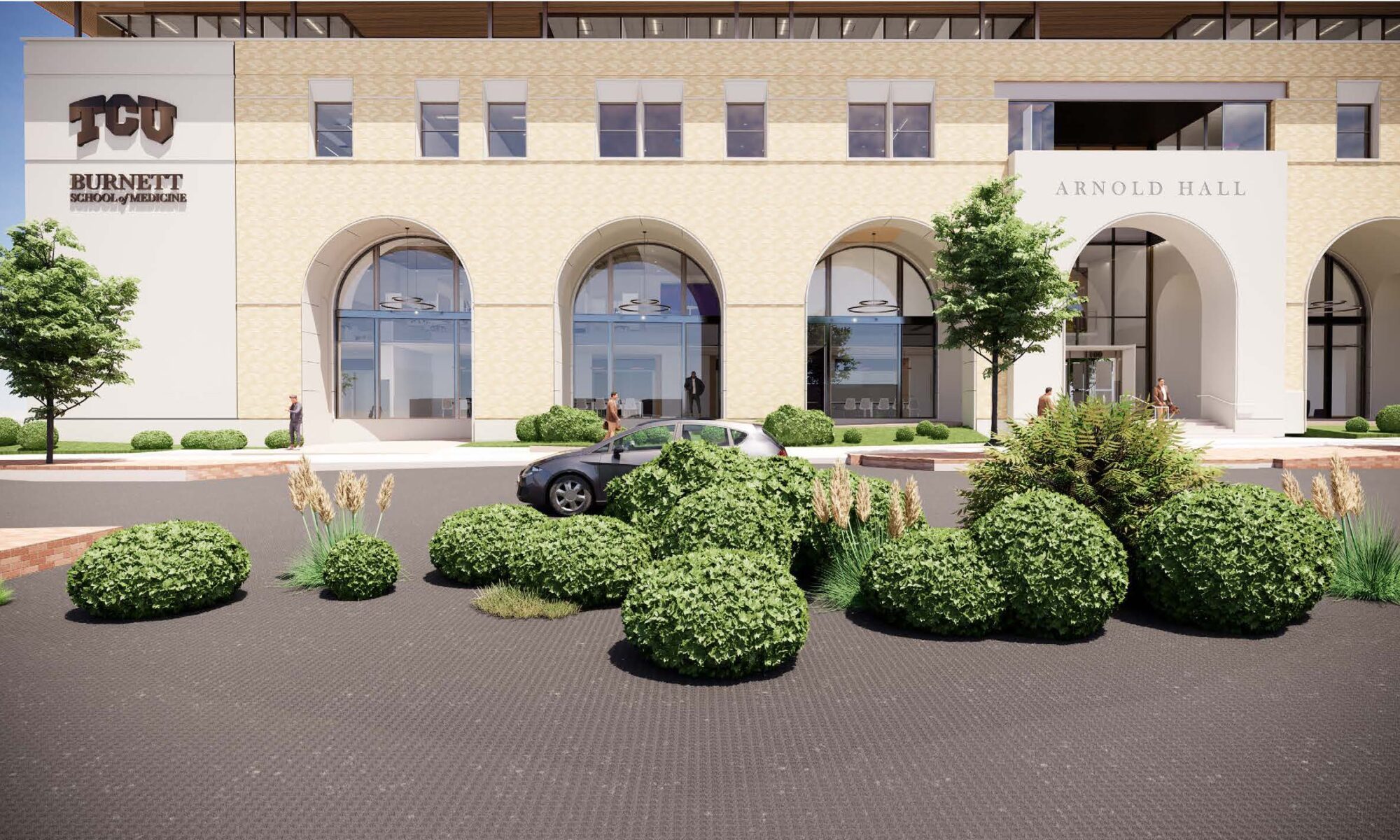
Arnold Hall at Anne Burnett Marion School of Medicine at Texas Christian University.

FORT WORTH – Ashley and Greg Arnold of Dallas, Texas, have made a major gift to establish The Ashley and Greg Arnold Endowment to provide perpetual support for annual operations of the Anne Burnett Marion School of Medicine at Texas Christian University. This gift also supported Lead On: A Campaign for TCU, the university’s boldest fundraising campaign in its 150-year history.

“On behalf of TCU, I would like to express our deepest appreciation to Ashley and Greg Arnold for this tremendous gift that will bolster the Burnett School of Medicine, including our talented and deserving students, faculty and staff, forever,” Chancellor Victor J. Boschini, Jr. said. “The Arnolds are making a profound difference in the life of this university and the future of medicine.”

The Arnolds have backed TCU for many years and have been especially active as parents. Their children include Horned Frogs Jordan Hendrix ’08, Anthony Arnold ’16, Regan Arnold ’18, and Carsen Kunzman, University of Miami ’20.

A member of the TCU Board of Trustees, Greg Arnold is chairman and CEO of TAC – The Arnold Companies, a privately owned family office investment and holding company with a diversified portfolio of investments featuring private and public companies. The company was built on services in petroleum marketing and private aviation, growing to national coverage in both industries in addition to being involved in real estate, banking and private investment activities. He is actively involved in his community through his leadership with education, underserved families and children and military and first responder support organizations. At TCU, he previously served on the Chancellor’s Advisory Council.

Ashley Arnold, whose professional background includes a leadership role at TAC and experience in pharmaceuticals, biotechnology and marketing, provides volunteer leadership to local and state organizations near her personal and professional interests, including medical research, higher education, under-served families and children, and military and first responder support organizations.

“Ashley and I are thrilled to help support TCU, and we are especially excited for the innovative work of the Burnett School of Medicine,” Greg Arnold said. “It’s important to us to support our community. The faculty, staff and students of the Burnett School are focused on compassionate health care, and having a facility of this caliber to excel in this learning will strengthen our community here in North Texas and beyond.”

This gift will support core operational needs of the school, which offers a novel educational experience tailored to how students learn best, capitalizing on teamwork and active application sessions, always keeping the patient at the center. Unique aspects of the program include communication skills instruction all four years; a curriculum that includes clinical training in a Longitudinal Integrated Clerkship, allowing students to follow a cohort of patients over four years, which is a major factor in the students retaining the significant empathy they have when they start medical school; and a flipped classroom model featuring active learning and no lectures.

All students are required to complete a four-year mentored research project, and they are supported through Academic and Executive coaches who focus on the students’ academic success, personal goals, career planning and well-being throughout medical school and beyond.

In recognition of the Arnolds’ generosity, TCU plans to name the new Burnett School of Medicine building “Arnold Hall,” which will be the permanent home of the Burnett School. Located in the Fort Worth Medical Innovation District, the 96,000-square-foot building will open in late spring of 2024.

“Naming this building for the Arnold family is a perfect fit for our school of medicine,” said Founding Dean Stuart D. Flynn, M.D. “It is an honor to have their name connected to our school and to beautifully grace our building, especially considering their personal interests in innovation and health care, as well as their significant contributions to the community. Their legacy sets a wonderful example for our students and inspires them to go above and beyond as servant leaders. We are incredibly grateful to the Arnold family for this fantastic gift that will support our mission in perpetuity.”

Among other areas at TCU, the Arnolds have supported the Neeley School of Business and the Spencer and Marlene Hays Business Commons. A TCU residence hall in Worth Hills is named for them in recognition of their extraordinary support of TCU through the years.

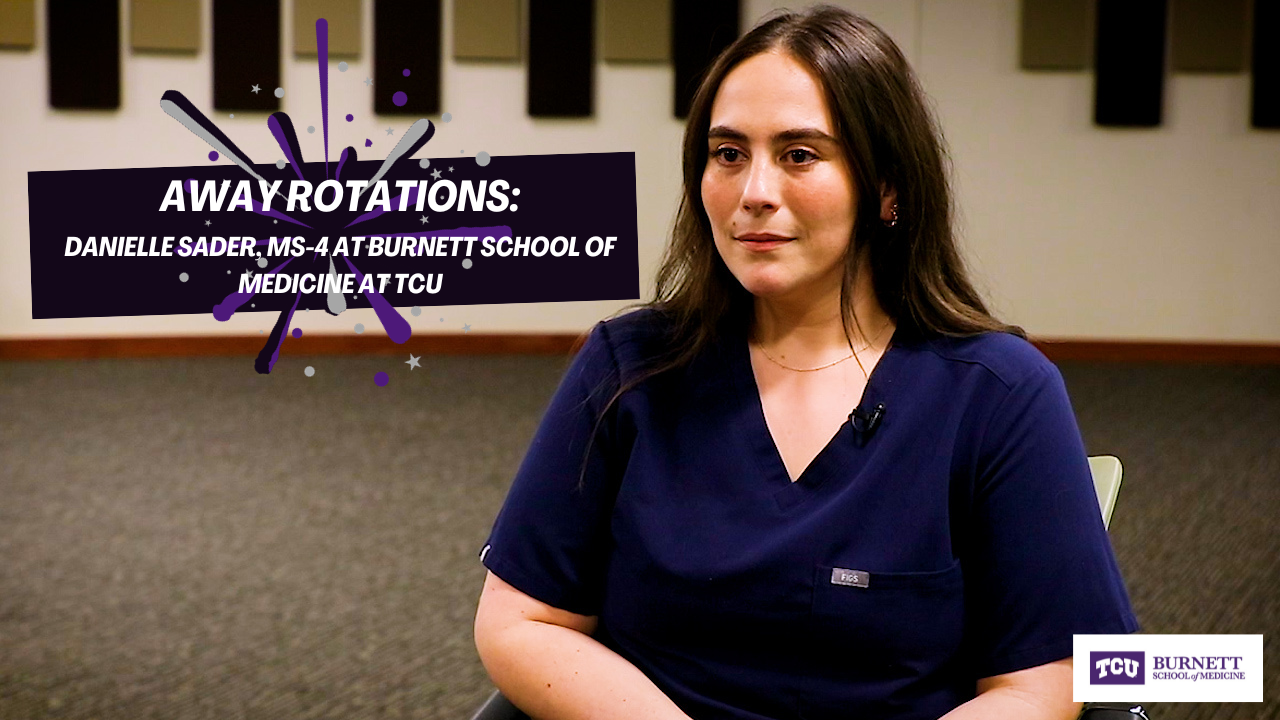
Away Rotations: Danielle Sader, MS4, Shares Experiences at Maimonides Medical Center and UNLV

Danielle Sader, MS4

FORT WORTH – As medical students across the United States enter their fourth-year for medical school the preparation for away rotations begin. Medical students apply to hospital or health care centers in the U.S. to land two to four-week audition for a Graduate Medical Education (GME)/residency positions. Away rotations are not required to apply to a residency program, but it gives medical students a chance to differentiate themselves from others and leave an impression on residency directors.  

Danielle Sader  

Hometown: Dallas, Texas 

Classification: MS-4 

Medical Specialty: Obstetrics-Gynecology (OB-GYN) 

Away Rotations: Maimonides Medical Center in Brooklyn, New York; UNLV Health in Las Vegas, Nevada, and Baylor, Scott & White Medical Center – Temple in Temple, Texas 

Away rotations for fourth-year medical students carry a huge weight. Medical students hope they leave a lasting impression on GME program directors. 

“You are showing these people what you can do and they are showing you what they have to offer,” said  Danielle Sader, MS-4 at Anne Burnett Marion School of Medicine at Texas Christian University. “You’re really auditioning for jobs at that point.”  

Sader, a Dallas native, traveled to Maimonides Medical Center, UNLV Health, and Baylor, Scott & White Medical Center – Temple for away rotations.  

“It’s so exciting to get to explore these new places and build your network even if that’s not where you end up doing residency,” Sader said.  

She described her role as the Inpatient Obstetrics & Gynecology Sub Intern in Labor & Delivery as a little bit of everything.  

“Any messages that need to be relayed to the rest of the team about medications or anything going on with their labor course,” Sader said. “I’ve also had the opportunities to be in a couple of deliveries and assist.”   

The preparation for away rotations for Sader and her classmates came under the watchful eye of Burnett School of Medicine at TCU faculty. Students are paired with physicians from their first day and it spans their entire time in medical school during their Longitudinal Integrated Clerkship (LIC)  

During their second-year, students get 10 weeks of inpatient hospital immersions and 40 weeks of clinical ambulatory rotations in eight medical specialties: Emergency Medicine, Family Medicine, Internal Medicine, Obstetrics & Gynecology, Neurology, Pediatrics, Psychiatry and Surgery. In their third-year, students continue to participate in comprehensive care of patients alongside a dedicated preceptor in those same medical specialties. 

“I really got to take some patients from their prenatal visits all the way through their pregnancy to their delivery,” Sader said. “When I got to my away rotations, no part of pregnancy was new to me.” 


Fort Worth’s Medical Innovation District is Ready for Growth, Arrival of Burnett School of Medicine at TCU

Construction is under way at the Medical Education Building at the Anne Burnett Marion School of Medicine at Texas Christian University in Fort Worth, Texas.

FORT WORTH – There’s a strong sense of community in Fort Worth’s Near Southside neighborhood and Medical Innovation District (MID) that will be home to the new medical education building for the Anne Burnett Marion School of Medicine at Texas Christian University. 

In episode 7 of “On Site: Construction of the Anne Burnett Marion School of Medicine at Texas Christian University with Founding Dean, Stuart D. Flynn, M.D.; Fort Worth City Councilwoman Elizabeth Beck, who represents District 9, known as the Near Southside, joined Dean Flynn for a tour of the neighborhood. 

“This is an area of the city that we’ve seen a tremendous amount of growth in the last 20 years,” Beck said. “We’ve gone from a lot of auto shops and industrial-type businesses to theaters and restaurants and stores up and down South Main and Magnolia streets.” 

Councilwoman Beck took Dean Flynn a few blocks away from the medical school’s medical education building on South Henderson and West Rosedale Streets to explore South Main Village, which is anchored by locally owned businesses on South Main Street. 

“This is one of my favorite areas of District 9 and one where I spend a lot of my free time,” Beck said. “I’m hoping TCU medical students enjoy it as much as I do.” 

The pair toured the Amphibian Stage, a theater on South Main Street, along with a visit to Morgan Mercantile, a family-owned shop that focuses on custom printed goods and merchandise experiences for brands, bands, and businesses. 

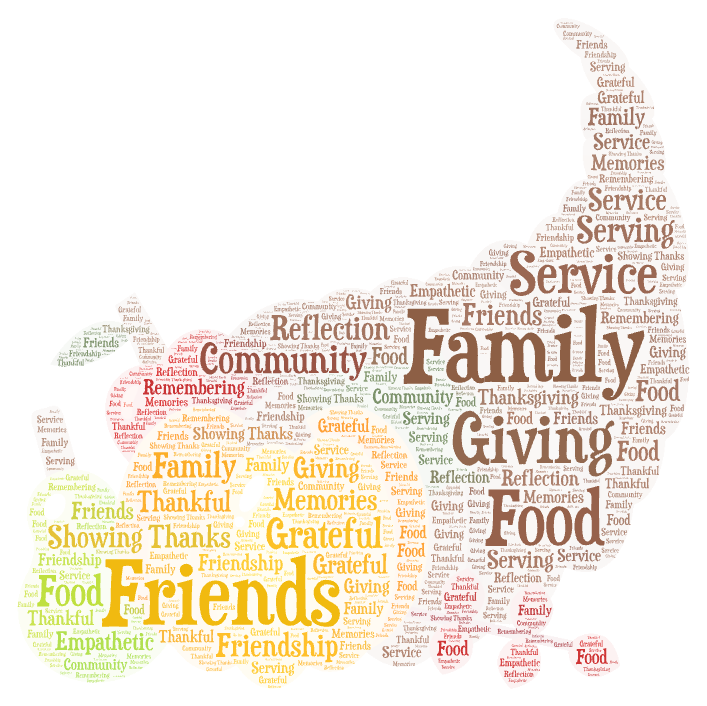
Burnett School of Medicine at TCU Students Share What Thanksgiving Means to Them

Anne Burnett Marion School of Medicine at Texas Christian University students shared words that described what Thanksgiving means to them.

Thanksgiving is a time for gathering and celebrating traditions with loved ones.

Marisa Fat, MS1 at the Burnett School of Medicine at TCU, said Thanksgiving is a time for reflection.

“The most important thing about Thanksgiving is being thankful for what you have,” she said.  “Thanksgiving means being grateful for anything you have, big or small.”

What is she most grateful for this year?

“I am thankful for so many things, but if I had to limit it, first and foremost would be my family,” she said. “I’m also really thankful to be at a medical school that truly does care about its students.”

Second-year medical student Simar Goyal said Thanksgiving is the one day “where you learn to respect and be grateful for everything that is going on in your life and for all the little things when nothing is going right.”

“Every day in clinic, I am thankful for patients opening up to me, for patients trusting me, and the connection I get to build with the community members, classmates, as well as my faculty and mentors,” said Sofia Olsson, MS3. “I am thankful for so many things. But I am tremendously thankful to be here, and for the opportunity to serve others and be a physician.”


Anne Burnett Marion School of Medicine at Texas Christian University students shared words that described what Thanksgiving means to them.

Essay: Bitter or Better – Are You a Glass or a Lake?

The winter holidays can be great, and often just what so many of us need. This time of year often finds us on the tail end of a season of work and life that has been busy, tiresome, and stressful. We need a break. We need some space. We need respite and renewal. Unfortunately, the default setting for fatigue, overwhelm, and stress (i.e. cortisol) is negativity and negative thinking, and we may unintentionally and unconsciously bring that tired, negative vision with us wherever we go. This does not create space. It does not provide rest. It does not revive. Based on how we are, not how things are, we miss the moments, the people, the experiences, and the opportunities that can be restorative, growth-promoting, and life-giving. Attributable to several thinkers, it’s been said that “we don’t see things as they are, we see them as we are.” What do you see? What don’t you see? And what might that reflect about how you are and what you might need?

In Mark Nepo’s, The Book of Awakening, he tells the story of a teacher frustrated with the bitterness of his apprentice.

An aging Hindu master grew tired of his apprentice complaining, and so, one morning, sent him for some salt. When the apprentice returned, the master instructed the unhappy young man to put a handful of salt in a glass of water, and then to drink it.

“How does it taste?” the master asked.

“Bitter,” spit the apprentice.

The master chuckled and then asked the young man to take the same handful of salt and put it in the lake. The two walked in silence to the nearby lake, and once the apprentice swirled his handful of salt in the water, the old man said, “Now drink from the lake.”

As the water dripped down the young man’s chin, the master asked, “How does it taste?”

“Fresh,” remarked the apprentice.

“Do you taste the salt?” asked the master.

“No,” said the young man.

At this, the master sat beside this serious young man who so reminded him of himself and took his hands, offering, “The pain of life is pure salt; no more, no less. The amount of pain in life remains the same, exactly the same. But the amount of bitterness we taste depends on the container we put the pain in. So when you are in pain, the only thing you can do is to enlarge your sense of things… Stop being a glass. Become a lake.”

Are you a glass or a lake? Do you first, or only, see the criticisms, the negativity, what’s wrong with everything? What comes from that? Really take some time to think through this.

Does the bitter taste of remaining a glass promote what you and I need most: expansion, growth, perspective, understanding, humility, compassion, and care? Does it illuminate what’s right, what’s working, the possibilities, the strengths, the solutions? Or does it propagate more negativity, more problems, and more hurt?

You and I, we can grow, we can expand our sense of things, we can be lakes. A foundational step, and one explicitly celebrated this holiday, is to practice savoring, gratitude, and thanksgiving.

As you move into the holiday season, consciously savor the experiences, the people, the food, the time off, the breaks, the weather, the parties, the fun, the deviations from the norm. Practice gratitude for the big things, the small things, the novel things, the mundane things, and the many things that make you, others, and life so unique and special. Gratitude acknowledged and expressed has many tremendous positive impacts. Empirically, gratitude nourishes, heals, and literally transforms the hearts, minds, and bodies of both the generators of gratitude and the receivers.

The far-reaching benefits of an attitude of gratitude reflect another truth of becoming a lake. A glass can only provide enough water for one drink. A great lake can provide water for so many more. As healers, life has called you to become a lake. Are you willing to do all that it takes to answer that call?

The strengths-perspective is founded on the wisdom that what’s right will fix what’s wrong. Look for what’s right. Savor it. Be grateful for it. And share your gratitude. In doing so, you will begin to grow from being a glass to being a lake, and this expansion will transform bitterness into something better, for you and every life you touch.

With gratitude and thanksgiving,

Craig Keaton, PhD, LMSW

Burnett School of Medicine at TCU Director of Wellbeing
Burnett School of Medicine Blood Drive Helps Community

Isabella Amado, MS3, gives blood at the Anne Burnett Marion School of Medicine at Texas Christian University in Fort Worth.

FORT WORTH – Every two seconds, someone in the United States needs blood, according to the American Red Cross.

That’s why the Anne Burnett Marion School of Medicine at Texas Christian University  recently  hosted a blood drive, hoping to bring awareness to the importance of giving blood.    

Approximately 29,000 units of red blood cells are needed every day in the United States, according to the American Red Cross.

“Blood is something that is always needed and always in short supply.” said Ric Bonnell, M.D., Director of Service Learning at the Burnett School of Medicine at TCU.  “You can’t stockpile 10 years worth of blood.  It’s a perishable commodity and then there’s many different blood types that needs to match the patient.  So, there’s always a national and international short supply of blood.” 

 The Red Cross says  one donation can help save more than one life.  This urgent need is one reason why Dr. Bonnell is wanting to host more blood drives.  

“We’re hoping to have it every three to four months at Burnett where our faculty and students are the ones that run it and donate blood.” 

Burnett School of Medicine at TCU is transforming health care by inspiring Empathetic Scholars, and a move like this is speaking to the school’s  mission. 

“It’s something that I want our students to experience and be a part of, the supply side of making sure that blood is available for the health care system,” Bonnell said. 

The American Red Cross says each year an estimated 6.8 million people in the U.S. donate blood.  If you would like to join them, log on to redcross.org and sign up. 

Away Rotations: Sereena Jivraj, MS4, Shares Experiences at Tufts, Stanford

Sereena Jivraj, MS4, talks about her away rotations at the Anne Burnett Marion School of Medicine at Texas Christian University in Fort Worth.

FORT WORTH, Texas (October 20, 2023)Away rotations are two to four-week programs where fourth-year medical students in the U.S. can audition for a Graduate Medical Education (GME)/residency positions at a hospital or health care center. Although away rotations are not required to apply to a residency program, it gives medical students an opportunity to distinguish themselves from other candidates and make a lasting impression on residency directors.   

Sereena Jivraj 

Hometown: Plano, Texas 

Classification: MS-4 

Medical Specialty: Obstetrics-Gynecology (OB-GYN) 

Away Rotations: Beth Israel Deaconess Medical Center in Boston, Massachusetts; Tufts Medical Center in Boston, Massachusetts; Stanford Health Care in Palo Alto, California 

Growing up as the youngest of four siblings, Sereena Jivraj, MS-4 at Burnett School of Medicine at TCU, never had the opportunity to be the big sister. 

“I always wanted to play big sibling or big mentor,” Jivraj said. “That played a role in me becoming a physician because I knew I would always have that big sibling role and have someone I could impart knowledge on.” 

Medical knowledge is currently growing at a rapid pace. As recent as 2020, it is estimated that medical knowledge doubles every 73 days, according to the National Institute of Health (NIH). To make sure that knowledge is transferable, and sticky requires medical students to get more hands-on training with physicians early and often, according to Sereena Jivraj, MS-4 at Burnett School of Medicine at TCU. 

“I was fortunate to be one on one with my OB-GYN preceptor for a long time,” Jivraj said. 

Students are paired with physicians from their first day at the Burnett School of Medicine . Jivraj also spent extra time with her Longitudinal Integrated Clerkship (LIC) preceptor whenever she had free time. 

“Besides the traditional 20 weeks that we are with our preceptors I was able to follow her afterwards.”  

In their second-year, students get 10 weeks of inpatient hospital immersions and 40 weeks of clinical ambulatory rotations in 8 medical specialties (Emergency Medicine, Family Medicine, Internal Medicine, Obstetrics & Gynecology, Neurology, Pediatrics, Psychiatry and Surgery). Each year, medical students in the United States are vying for residency positions at hospitals and health care systems during away rotations.  

Jivraj had already delivered 30 to 40 babies during her LIC experience prior to her away rotations. She was able to establish trust with her attending physicians very quickly, she added.  

 “They felt comfortable having me help them with deliveries in the operating room,” Jivraj said.  

The skills she sharpened during the LIC curriculum helped her take on more of a big sibling role while on her away rotations.   

“With residents and other learners I was able to impart the knowledge that I had received in this educational setting,” Jivraj said.    

Burnett School of Medicine at TCU Students Use Design Thinking to Solve Health Care Issues

First-year medical students participating in a Design Thinking exercise at the Anne Burnett Marion School of Medicine at Texas Christian University in Fort Worth, Texas.

FORT WORTH– A classroom filled with medical students drawing on poster boards might have given an observer the impression that the students were participating in an art class.

However, this burst of colorful creativity by the students was part of a process to tackle serious health-care issues. The students spent a week learning the principles of design thinking to focus on patient and provider needs, and to prioritize empathy.

“This allows them to use a different way of thinking,” said Stacy Grau, Ph.D., Associate Professor at Anne Burnett Marion School of Medicine at Texas Christian University.  “It’s a nice opportunity to explore your creative side.” 

A forward-thinking curriculum called Future Accelerators of Medicine and Beyond (F.A.B.) created by Stuart D. Flynn, M.D., the Founding Dean of Burnett School of Medicine TCU, exposes medical students to emerging concepts that could benefit them throughout their medical careers.  

Each academic year F.A.B. has four separate weeklong courses that focus on artificial intelligence, genomics, design thinking and assays of the future 

Throughout the design thinking week, first-year medical students learned how to use ideation, prototyping and testing to solve health care issues for pregnant women and older adult populations. Specifically, the students were asked to find solutions to health, wellness, and activity levels for those two patient populations.  

“This year we really stressed the technology piece,” Grau said. “How can we use artificial intelligence? How can we use wearables? How can we use other aspects of digital technology?” 

The students were separated into 10 groups and met with Fort Worth-area community members to learn about their most pressing issues. Each group then presented  a concept poster that introduced a prototype and their ideas for a solution.  

“It’s a low fidelity prototype and a simple way for them to show what their idea is,” Grau said. “They also get an idea of what success can look like and also ways that it could fail.”  

Virtual Reality Technology Allows Medical Students More Insight Into the Human Eye

View inside OcuSim

FORT WORTH – Most medical students learn about the anatomy of the human eye through two-dimensional graphics.

Students at the Anne Burnett Marion School of Medicine at Texas Christian University now have access to what one faculty member calls the “wave of the future” for ophthalmology.

“Right before you is a gigantic eye in a 3-D sense,” said Kevin Chao, MS-3, after using the new technology.

“It was like the Magic School Bus going into the little eye, it was pretty cool,” he said referring to the popular children’s animated TV series about science.

The new virtual reality training simulator called OcuSim, which was purchased by the Burnett School of Medicine through the Alcon Endowment for Ophthalmology Excellence, allows medical students an immersive experience and more insight into the human eye. OcuSim uses an Oculus headset that is designed for medical students to achieve mastery learning through deliberate practice.

OcuSim is the wave of the future, according to Adam Jennings, D.O.,  Executive Director of Simulation, Innovation and Research at the Burnett School of Medicine at TCU.

“Instead of having a book or a PowerPoint you have that immersive experience,” Dr. Jennings said. “That material is embedded so much deeper in your brain you can recall it for the majority of your career.”

Anuradha Khanna, M.D., Vice Chair of Education in the Department of Ophthalmology at Loyola University Chicago Stritch School of Medicine, along with other collaborators developed OcuSim a virtual reality ophthalmic training simulator designed for educators to use in a classroom. It puts the students in a virtual environment with three-dimensional illustrations of the human eye. Students can look inside and interact with the eye structure. Each illustration has an array of colors and labels the important structures based on the lesson.

Dr. Khanna introduced OcuSim to third-year medical students at Burnett School of Medicine during a recent LEAPs session.

Simulation provides an environment for students to apply their knowledge and experience; safely build confidence in clinical and technical skills; and make decisions without actual risk to patients. Virtual reality is one way to connect with medical students on a deeper level, Dr. Jennings added.

“A lot of times medical education is not that progressive and we’re at the cutting-edge of that,” Dr. Jennings said. “You see the anatomy come to life and it cements that in your brain and makes that much more of an impact.”